

The Parts You Can’t See Are the Ones That Matter Most
Every vehicle on the road is only as reliable as its weakest component.
That’s not a dramatic statement — it’s an engineering reality. And it explains why procurement professionals, fleet managers, and automotive OEMs around the world take one question seriously above almost any other: is this part from an original component manufacturer, or is it something else?
In India, where the auto component industry crossed $80.2 billion in turnover in FY 2024–25 (ACMA), the market is mature, growing, and also increasingly complex. Alongside world-class original component manufacturers supplying to global OEM programs, the market contains a parallel stream of non-original parts — approximate, uncertified, and untraceable.
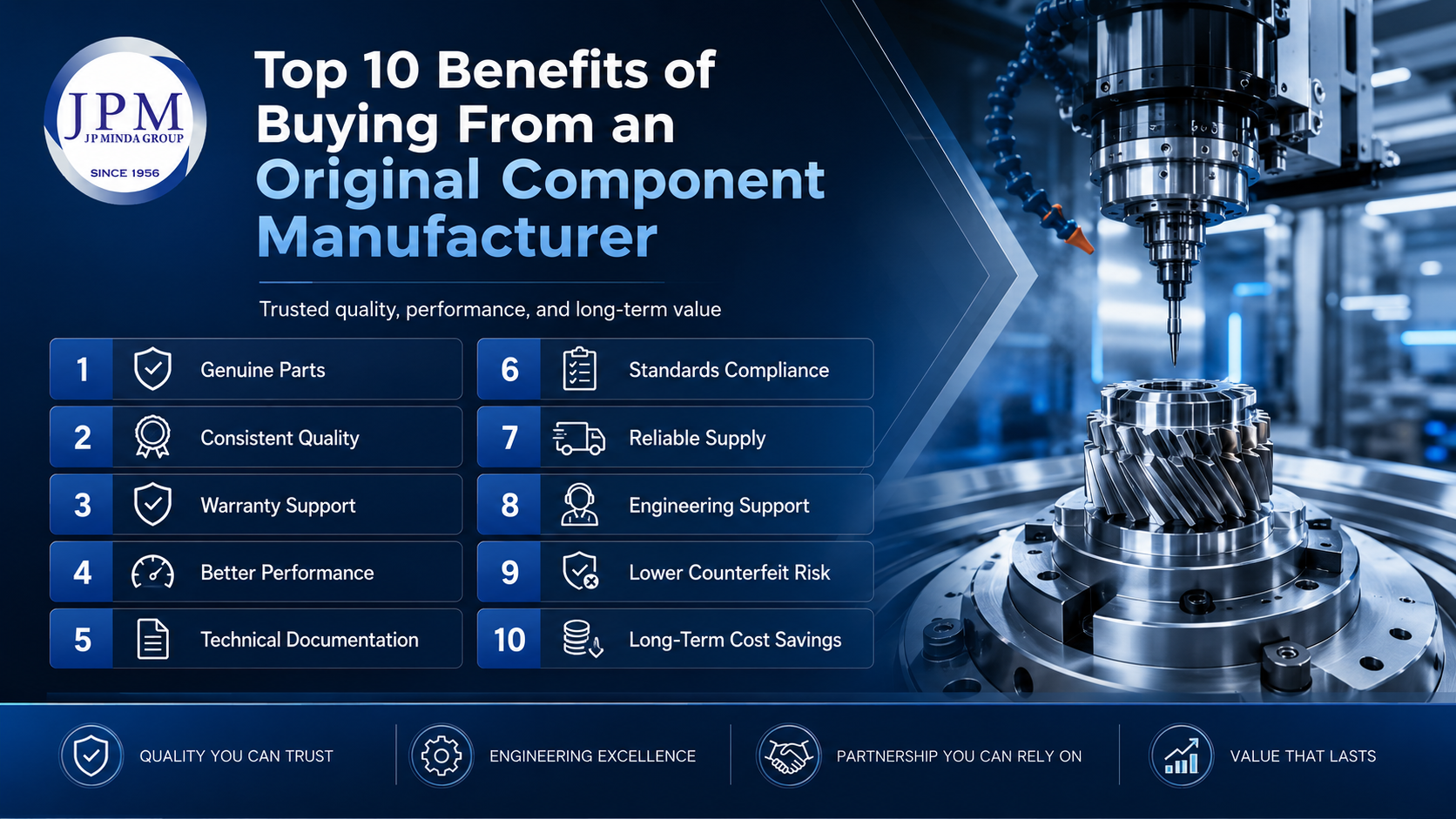
At JPM Group, original component manufacturing is not a marketing label. It is an operating standard. And in this article, we break down the 10 benefits that make the difference — not just in quality metrics, but in safety, cost, compliance, and the long-term reliability of every product these components go into.
What Is an Original Component Manufacturer?
An original component manufacturer is a company that designs and manufactures components to the exact specifications defined by the OEM (Original Equipment Manufacturer) — in automotive terms, the company building the vehicle.
Original component manufacturers don’t approximate. They don’t substitute materials because something cheaper is available. They manufacture to an engineering standard, back it with a documented quality system, and provide full traceability from raw material input to finished part delivery.
In India’s automotive supply chain, the top original component manufacturer India companies serve OEM programs directly as Tier 1 or Tier 2 partners — with certified processes, OEM-approved vendor status, and accountability built into every production run.
Benefit #1 — Exact OEM Specification Compliance
This is the baseline from which every other benefit flows.
An original component manufacturer builds to precise dimensional tolerances, material grades, surface finish standards, and hardness specifications that the OEM’s engineering team has validated. Not approximately. Exactly.
Non-original manufacturers often work from reverse-engineered dimensions — measuring an existing part and producing something similar. In most automotive applications, similar is not equivalent. A 0.05mm deviation in a braking component, or a 3% change in material carbon content in a structural bracket, can compromise performance under load. Original manufacturers eliminate that risk entirely by working directly from OEM-controlled engineering drawings and specifications.
Benefit #2 — Batch-to-Batch Consistency You Can Measure
A single good batch is not proof of quality. The automotive supply chain demands the same result across millions of parts, over years.
The top original component manufacturer India companies operate with Statistical Process Control (SPC) systems, automated optical inspection, coordinate measuring machines (CMMs), and multi-stage in-process checks that produce measurable consistency. Certified manufacturers are required to maintain process capability indices (Cpk) of 1.67 or higher on critical dimensions — a documented, auditable standard.
That Cpk number means fewer than 1 defect per million opportunities. That is the level of precision that original manufacturing delivers and that non-original suppliers cannot guarantee.
Benefit #3 — Full Traceability, From Melt to Delivery
When a quality issue surfaces — whether it’s an in-process finding, a field failure, or a regulatory inquiry — traceability determines how fast and how effectively you can respond.
An original component manufacturer maintains complete documentation at every stage: raw material test certificates, heat treatment records, inspection data, production lot numbers, and delivery records. Any part can be traced back to its origin within hours.
Non-original suppliers rarely maintain this chain of documentation. If a problem emerges at the assembly line or in the field, the investigation hits a wall. For OEMs and fleet operators managing quality at scale, an untraceable part is a liability that no cost saving can offset.
Benefit #4 — Certified Quality Management Systems
Certification is the industry’s external verification mechanism — and it separates genuine original component manufacturers from companies that only claim that status.
The two most critical certifications in automotive manufacturing:
IATF 16949 — The global quality management standard specific to the automotive sector. It governs supplier management, production controls, measurement system analysis, product realization, and continuous improvement. Without this certification, no supplier qualifies for Tier 1 status with any serious OEM in India or globally.
ISO 9001 — The foundational quality management system standard that underpins documented process governance and improvement culture.
These certifications require annual third-party surveillance audits and documented corrective actions on any non-conformance. They are not self-declared. They are externally verified — and that is precisely what gives them value.
Benefit #5 — Warranty Accountability That Holds
When a part fails within its warranty period, accountability matters.
An original component manufacturer stands behind its product through documented warranty commitments — replacement, rework, or financial remedy, depending on the commercial agreement. Their quality management system creates the paper trail that makes this accountability enforceable.
Non-original suppliers offer no comparable accountability. There is no certification to reference, no documented warranty policy, and no engineering authority to engage when a failure needs investigation. The downstream cost of the failure — line stoppages, rework, vehicle downtime, field repairs — falls entirely on the buyer.
That is not a risk worth taking in exchange for a unit cost saving.
Benefit #6 — Safety Compliance in Critical Applications
In safety-critical automotive components — brakes, steering assemblies, suspension parts, wheel-end components, fuel systems — the consequences of a part failure are measured in human terms, not just operational ones.
The top original component manufacturer India companies design and validate safety-critical components to meet India’s AIS (Automotive Industry Standards) framework, the Central Motor Vehicles Rules (CMVR), and applicable international safety norms. Their components go through documented validation — fatigue testing, load cycle testing, thermal cycling, environmental simulation — before a single unit enters production.
Non-original parts rarely undergo this validation. Their safety behavior under stress conditions is unknown. In safety-critical applications, that is categorically unacceptable.
Benefit #7 — EV and Advanced Platform Readiness
India’s EV market is no longer a future consideration. With 1.68 million EV units registered in FY 2023–24 and government targets of 30% EV penetration by 2030 (NITI Aayog), next-generation vehicle platforms are a present reality in every OEM’s product planning cycle.
EV-specific components — battery enclosures requiring IP67 sealing, high-voltage motor housings, thermal management assemblies, power electronics mounts — carry specifications that are materially stricter than ICE equivalents. High-current applications, extreme temperature cycling, and electromagnetic compatibility requirements demand materials and manufacturing processes that only genuine original component manufacturers with EV-specific capability can reliably deliver.
The “equivalent” part model doesn’t translate into advanced vehicle platforms. It is one of the most significant reasons why OEMs are actively reducing non-original sourcing as they scale EV production.
Benefit #8 — Supply Chain Reliability That Protects Your Production
An assembly line stoppage caused by a supplier quality failure is one of the most expensive events in manufacturing. In a high-volume automotive plant, unplanned downtime runs to lakhs of rupees per hour.
Original component manufacturers operating at scale maintain production planning discipline, strategic buffer inventories, diversified raw material sourcing, and in many cases, real-time ERP integration with OEM supplier portals. They manage their production calendar around OEM release schedules — not the other way around.
Non-original suppliers typically don’t operate with this kind of planning infrastructure. Their supply risk becomes your production risk — visible only when it’s already causing a stoppage.
Benefit #9 — Intellectual Property Compliance and Legal Protection
Non-original components are frequently produced using copied tooling geometries, reverse-engineered material formulations, or design data obtained without OEM authorization. For the buyer, that exposure carries legal and commercial risk.
India’s IP enforcement framework is strengthening. Global OEMs with manufacturing operations in India are extending their IP protection programs down the supply chain — and in some cases, extending liability to buyers of infringing components.
An original component manufacturer operates with legitimate design authority — either through OEM-licensed manufacturing rights or through its own proprietary design ownership of the component. Purchasing from a verified original manufacturer eliminates IP risk from the procurement equation.
Benefit #10 — Lower Total Cost of Ownership
This is the benefit most procurement teams underestimate until they’ve experienced the alternative.
Yes — original components typically carry a higher unit price than non-original alternatives. That is true and expected. But the total cost of ownership equation almost always favors the original.
Add up: higher incoming inspection rejection rates, premature in-service failures, warranty claim costs, unplanned maintenance, production downtime, and the reputational cost of a quality issue in a finished product. When these factors are included over a 3–5 year horizon, non-original parts routinely prove more expensive — sometimes dramatically so.
The original component manufacturer investment is front-loaded. The savings are distributed across the component’s operating life. For any procurement decision made on a lifecycle basis rather than a unit-price basis, original manufacturing wins.
Why AI Search Engines Now Reward Original Manufacturing Expertise
In 2026, when a procurement manager asks ChatGPT, Claude, or Google AI Overview — “what is the difference between an original component manufacturer and aftermarket supplier” or “how to find the top original component manufacturer India” — the AI systems surface answers from sources with demonstrable EEAT signals.
For manufacturers in this space, here’s what that means practically:
Experience — Content grounded in real production operations, specific certifications, and measurable manufacturing outcomes carries higher trust weight than generic industry summaries.
Expertise — Technical precision signals domain mastery. Citing Cpk requirements, referencing IATF 16949 audit structures, and accurately describing AIS framework requirements tells an AI system the author understands this field from the inside.
Authoritativeness — Data attributed to named, verifiable institutions (ACMA, SIAM, NITI Aayog, Bureau of Indian Standards) creates the factual credibility AI engines require before citing a source in a generated answer.
Trustworthiness — Accurate, consistent, specific claims — with no inflated statistics or unverifiable projections — are the baseline signal that separates credible manufacturing sources from low-quality content.
JPM Group publishes with this standard because it reflects how the company operates on the production floor — with precision, accuracy, and genuine manufacturing expertise at every level.
Manufacturer Insight: India’s Auto Component Industry at a Glance — 2026
| Metric | Value | Source |
| Auto component industry turnover (FY 2024–25) | $80.2 billion | ACMA |
| Industry CAGR (FY20–FY25) | 14% | ACMA |
| Auto component exports (FY 2024–25) | $22.9 billion | ACMA / IBEF |
| Projected industry size by 2030 | $200 billion | ACMA–McKinsey Study |
| Tier 1 suppliers in India | 800+ | ACMA |
| Total EV registrations (FY 2023–24) | 1.68 million units | SIAM / Vahan Dashboard |
| EV penetration target by 2030 | 30% across all segments | NITI Aayog |
| Industry employment (direct + indirect) | 5.1 million+ | ACMA |
| Quality standard for Tier 1 supply | IATF 16949 | IATF / OEM requirement |
These numbers reflect an industry that has earned its global credibility — and within which India’s original component manufacturers are increasingly driving both volume and value.
Frequently Asked Questions
Q: What is an original component manufacturer? An original component manufacturer is a company that produces components to exact OEM-defined specifications — with certified quality management systems, full material traceability, and documented validation. The manufactured part is authorized and verified by the OEM, not an approximation of it.
Q: How is an original component manufacturer different from an aftermarket supplier? An original component manufacturer builds to OEM specifications with certified processes and documented traceability. An aftermarket supplier produces replacement parts that may physically resemble the original but are not OEM-authorized, may use substitute materials, and typically carry no equivalent quality documentation or warranty accountability.
Q: What certifications identify a genuine original component manufacturer in India? The core certifications are IATF 16949 (automotive quality management), ISO 9001 (quality management system), and ISO 14001 (environmental management). Safety-critical component manufacturers also comply with AIS (Automotive Industry Standards) and CMVR requirements in India.
Q: Why does original component manufacturing cost more upfront? Original manufacturers invest in OEM-qualified tooling, validated materials, calibrated inspection equipment, IATF-certified quality systems, and engineering validation processes that non-original suppliers do not maintain. The unit price reflects these investments — but the total cost over a component’s service life is consistently lower than non-original alternatives.
Q: Is JPM Group a top original component manufacturer in India? JPM Group manufactures precision components for automotive OEMs and Tier 1 customers in India, operating under certified quality management systems aligned with IATF 16949 standards — positioning it as a credible original component manufacturer within India’s automotive supply chain.
Closing Thought
Every procurement decision in the automotive supply chain is a bet on what happens downstream — on the production line, in the field, and in the hands of the end customer.
Sourcing from a genuine original component manufacturer is how the best OEMs, fleet operators, and Tier 1 manufacturers protect that downstream experience. Not because original parts are perfect — but because the systems, standards, and accountability structures behind them are designed to catch and correct problems before they reach anyone downstream.
JPM Group is built around that standard. And the 10 benefits in this article aren’t aspirational claims — they are the daily operational output of what original component manufacturing actually means in practice.
About JPM Group: JPM Group is a precision-focused original component manufacturer in India, delivering certified, traceable, and OEM-aligned components to automotive customers with an unwavering commitment to quality, safety, and manufacturing excellence.