

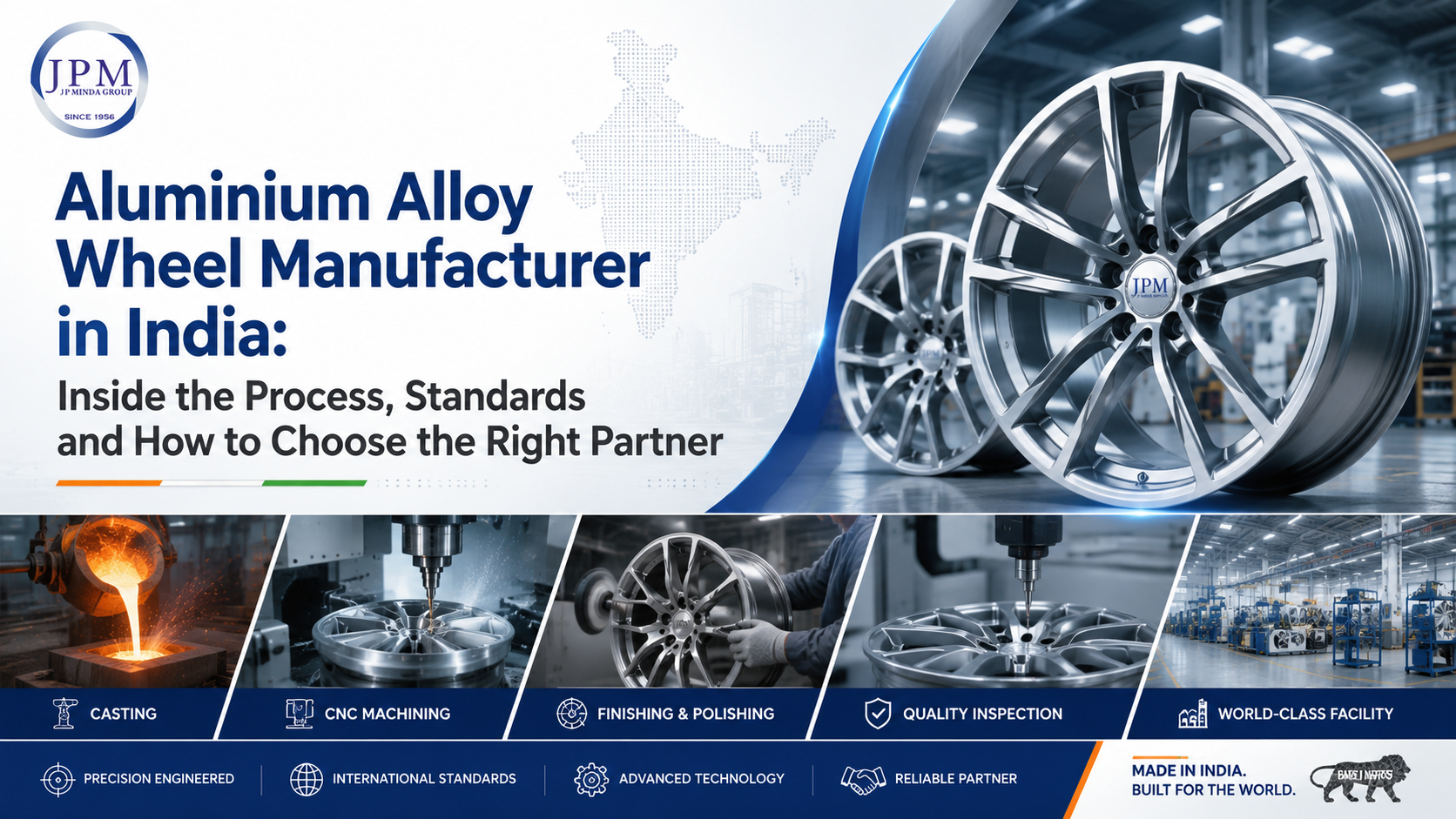
Walk through any car showroom in India today, and the wheels tell their own story. A decade ago, alloy wheels were a premium add-on reserved for top trims; today, they’re close to a default expectation across most segments, and the manufacturers behind them have had to scale up just as fast as the car market they serve.
Maybe you typed “aluminum alloy wheel manufacturer India” into a search bar looking for a sourcing partner, or you’re simply trying to tell a dependable car alloy wheel manufacturer in India apart from one cutting corners on a wheel you can’t inspect once it’s painted and mounted. Either way, this guide is meant to answer that properly.
Finding the right aluminium alloy wheel manufacturer in India isn’t a matter of picking the lowest number on a quote sheet. A wheel sits at the intersection of safety, weight, ride quality and design — get the casting, the heat treatment, or the testing wrong, and it shows up on the road, not in a lab report. Below: how alloy wheels are cast and tested, why India has become such a significant manufacturing base, which certifications matter, and how to think about sizing — including a 13 inch alloy wheel manufacturer’s typical catalogue versus a 15 inch alloy wheel manufacturer’s, in a market shifting fast toward SUVs. At JJF Casting, this is the level of detail we think buyers deserve before committing to a supplier.
What Actually Makes an Aluminium Alloy Wheel Different From Steel
An alloy wheel, strictly speaking, is cast or forged from a non-ferrous metal alloy — almost always an aluminium-silicon alloy — rather than stamped from sheet steel, a distinction that matters beyond appearance.
Aluminium conducts heat considerably better than steel, helping brakes shed heat faster on hilly routes or in stop-start traffic. It’s also lighter for a comparable structural load, reducing unsprung mass — the portion of a vehicle’s weight not cushioned by the suspension — which lets the suspension react faster to a pothole, a real difference on Indian roads, and shaves a small but measurable percentage off fuel consumption.
The tradeoff is cost and repairability: a cracked alloy wheel usually needs replacement or specialist welding, while a dented steel wheel can often be hammered back into shape at a roadside garage. For most buyers, the handling and efficiency gains are worth it, which is why alloy wheels have moved from optional extra to near-standard equipment across the Indian passenger vehicle lineup.
| Factor | Aluminium Alloy Wheels | Steel Wheels |
| Weight | Lighter; reduces unsprung mass | Heavier |
| Heat dissipation | High — cools brakes faster | Comparatively low |
| Fuel efficiency | Slightly improved | Baseline |
| Design and finish options | Wide range of spoke patterns and finishes | Limited; usually covered with hubcaps |
| Corrosion resistance | Naturally resistant | Prone to rust without coating |
| Repair after damage | Often needs replacement or specialist repair | Easier to reshape after minor damage |
| Typical upfront cost | Higher | Lower |
Inside the Manufacturing Process: How an Alloy Wheel Is Actually Built
Most buyers never see what happens between a raw aluminium ingot and a finished wheel — and that’s exactly where quality is won or lost.
- Melting and alloying. Production starts with high-purity aluminium, typically alloyed to an A356 or A357 specification chosen for how well it responds to heat treatment later. The molten metal is degassed and filtered to remove hydrogen and oxide inclusions, the leading cause of porosity defects down the line.
- Casting. Gravity die casting pours molten metal into a mould under gravity alone — simple and economical, for less demanding wheels. Low-pressure die casting (LPDC), behind most OEM passenger-car wheels, pushes metal upward into the mould under controlled air pressure, producing a denser grain structure with fewer trapped gas pockets than gravity casting, and better fatigue performance as a result. Forged wheels press a solid billet under thousands of tonnes of force for the best strength-to-weight ratio at a higher cost; performance wheels often add flow forming afterward, spinning the rim to refine its grain structure.
- Quality screening. Cast wheels go through X-ray inspection to catch internal porosity invisible from the outside.
- Heat treatment. Wheels that clear inspection go into a T6 cycle — solution treatment around 530–540°C for several hours, a rapid quench, then artificial ageing — taking a wheel from a soft, brittle as-cast state to one with the strength and ductility for years of cornering and pothole loads. This step alone often outlasts the casting itself: a full T6 cycle can run past 10 hours against a minute or two of mould-filling, and shortening it is one of the easiest invisible corners for a low-cost supplier to cut.
- Machining and finishing. Wheels are CNC-machined to final dimensions — pitch circle diameter, offset, hub bore, valve hole — to tolerances of a few hundredths of a millimetre, since small errors show up as vibration at speed. Shot blasting prepares the surface before priming and a powder coat, liquid paint or diamond-cut finish, sealed with clear coat for corrosion protection.
- Final testing. Wheels undergo a radial fatigue test, a cornering fatigue test, and an angled impact test simulating a kerb or pothole strike — the three tests behind every recognised wheel-safety framework — plus balance and air-tightness checks.
This is the standard a serious car alloy wheel manufacturer in India works to, whether a wheel is headed for an OEM line or an aftermarket counter. At JJF Casting, each stage is a checkpoint, not a formality — a wheel that fails quietly at any one of them doesn’t get a second chance on the road.
| Method | How It Works | Typical Use | Relative Cost |
| Gravity Die Casting (GDC) | Molten metal poured into a mould under gravity alone | Entry-level and standard wheels | Lowest |
| Low-Pressure Die Casting (LPDC) | Controlled air pressure pushes metal upward into the mould | Most OEM passenger car wheels | Moderate |
| Flow Forming | A cast wheel’s rim is reheated and spun/stretched under rollers | Lightweight performance wheels | Moderate–high |
| Forged | A solid billet is pressed into shape under extreme force | High-performance and premium wheels | Highest |
Why India Has Become a Major Hub for Alloy Wheel Manufacturing
A few converging factors explain why so much of this manufacturing has concentrated in India over the past decade.
The first is raw material access. India is the world’s second-largest primary aluminium producer, trailing only China and accounting for roughly 6% of global output, backed by some of the largest bauxite reserves anywhere — a proximity that shortens supply chains and insulates domestic wheel manufacturers from price volatility hitting import-dependent markets elsewhere.
The second is the size of the downstream market. India overtook Japan in 2023 to become the world’s third-largest passenger vehicle market, with annual sales past 4.5 million units and climbing toward 5 million. What’s selling has shifted hard toward SUVs and utility vehicles, now over half of all sales nationally — close to a full reversal of the hatchback-dominated market of a decade ago — and larger vehicles generally specify larger wheels, pulling demand upward across the size range a car alloy wheel manufacturer in India needs to stock.
Third, India has become a genuine export base: passenger vehicle exports alone crossed 770,000 units in a recent fiscal year, and government programmes targeting component manufacturing, including aluminium processing, are adding further momentum to capacity expansion.
Standards and Certifications Worth Checking Before You Buy
This is where a lot of buyers — especially first-time aftermarket buyers — skip a step that actually matters.
In India, wheel rims for two- and three-wheeled vehicles are governed specifically by AIS-073, administered by the Automotive Research Association of India (ARAI) under the Central Motor Vehicle Rules. Passenger car (M1 category) wheels go through a broader ARAI type-approval process, and credible manufacturers typically test against the same fatigue and impact protocols used internationally — including ISO 3006 (cornering and radial fatigue), ISO 7141 (lateral impact), Japan’s JWL/VIA framework, and SAE J2530 in North America. None of these are interchangeable rubber stamps; each describes a specific, repeatable lab test a wheel design has to survive before it’s considered road-ready.
Beyond wheel-specific testing, check whether a manufacturer holds ISO 9001 certification at a minimum, and ideally IATF 16949 — the automotive industry’s own quality standard, which goes further on defect prevention and supply chain traceability. A manufacturer that can produce actual test reports against these benchmarks, not just a brochure, is one worth taking seriously.
Choosing the Right Wheel Size: 13 Inch vs 14 Inch vs 15 vs 22 Inch Alloy Wheels
Wheel size sounds like a cosmetic choice, but it changes how a car rides, brakes and handles — and it changes what a manufacturer has to engineer for.
A 13 inch alloy wheel manufacturer today mostly serves a shrinking slice of the market — older vehicles still on the road, certain budget trims, and spare-wheel applications. Smaller-diameter wheels were the default a generation ago, but have been steadily phased out of new-vehicle fitment as cars and brake callipers have grown larger.
A 14 inch alloy wheel manufacturer, by contrast, works in what’s still the highest-volume segment in the country: compact hatchbacks and entry-level sedans, the bulk of first-time buyer purchases, overwhelmingly run on 14-inch fitments. The appeal is straightforward — lighter weight helps fuel economy, a taller sidewall absorbs potholes better than a low-profile setup, and replacement tyres stay cheaper.
A 15 inch alloy wheel manufacturer increasingly serves the segment growing fastest right now: premium hatchbacks, mid-size sedans, and compact SUVs. The extra inch buys more brake-calliper clearance, a wider contact patch, and a sportier stance — at the cost of a firmer ride and a higher tyre price.
A manufacturer that genuinely covers this full range, rather than specialising in one size, is better positioned to support both OEM programmes and aftermarket demand, where customers often want to size up from what their car shipped with. That breadth is part of what JJF Casting has built its production planning around.
| Size | Typically Found On | Ride Character | Replacement Tyre Cost |
| 13 inch | Older or entry-level cars, spare wheels | Most cushioned; tallest sidewall | Lowest |
| 14 inch | Compact hatchbacks, entry-level sedans | Comfort-focused; strong pothole absorption | Low |
| 15 inch | Premium hatchbacks, sedans, compact SUVs | Firmer, sportier; better brake clearance | Moderate |
How to Evaluate an Aluminium Alloy Wheel Manufacturer in India
A few practical questions are worth asking before placing an order with any manufacturer:
- Can they show actual test reports — radial fatigue, cornering fatigue, impact — for this wheel design, not just a generic certificate?
- What casting method suits the size and load rating you need, and why?
- Is CNC machining and finishing in-house, or outsourced? Outsourced finishing is a common source of hidden inconsistency.
- What’s their defect rate, and is it backed by a documented quality system, or a verbal assurance?
- Can they support both small custom runs and high-volume OEM orders, or only one end of that range?
- Is there a clear warranty process if a wheel fails prematurely?
These aren’t trick questions — they’re what a serious OEM sourcing team would ask, and a manufacturer confident in its process should answer them without hesitation. It’s the kind of conversation we’d welcome at JJF Casting, and one worth having with any car alloy wheel manufacturer in India you’re evaluating.
Frequently Asked Questions
What’s the difference between cast and forged alloy wheels? Cast wheels are made by pouring or pressure-filling molten aluminium into a mould — the route used for most passenger car wheels. Forged wheels start from a solid billet pressed into shape under extreme force, giving a stronger, lighter wheel at a noticeably higher cost.
Which wheel size is right for my car? That depends on your factory specification, brake calliper size, and what you’re optimising for. Staying close to factory size keeps ride comfort predictable; sizing up from 14-inch to 15-inch typically firms the ride and sharpens handling, at a higher tyre cost.
How long do aluminium alloy wheels actually last? With normal use and no major impact, a properly manufactured alloy wheel can comfortably outlast the vehicle it’s fitted to. Cracks, heavy corrosion, or a hard kerb or pothole strike — not ordinary fatigue — are the usual reasons for early replacement.
Can a manufacturer customise wheels to OEM specifications? Yes. Established manufacturers can match a specific PCD, offset, hub bore and load rating to OEM drawings, and many also support custom finishes for aftermarket or fleet-branding programmes.
Is there a real quality difference between OEM-supply and aftermarket alloy wheels? Not necessarily in materials, but often in process — OEM-supply wheels carry extensive sign-off testing before mass production, while aftermarket quality varies more widely, which is exactly why checking test reports matters most in that channel.
Final Thoughts
A wheel is one of the few parts on a car that’s both structural and visible — it has to survive years of fatigue loading and look right doing it, which is exactly why the casting method, the heat treatment, and the testing regime behind it matter as much as the finish on top.
Whether you’re sourcing for an OEM programme, stocking an aftermarket counter, or simply trying to understand what you’re paying for, the questions stay the same: how is it cast, how is it heat treated, what’s it tested against, and can the manufacturer prove it. JJF Casting works to that standard across the 13, 14 and 15 inch range that covers most of what’s on Indian roads today, and we’re glad to walk through test reports or a specific spec sheet with anyone seriously evaluating a supplier.