

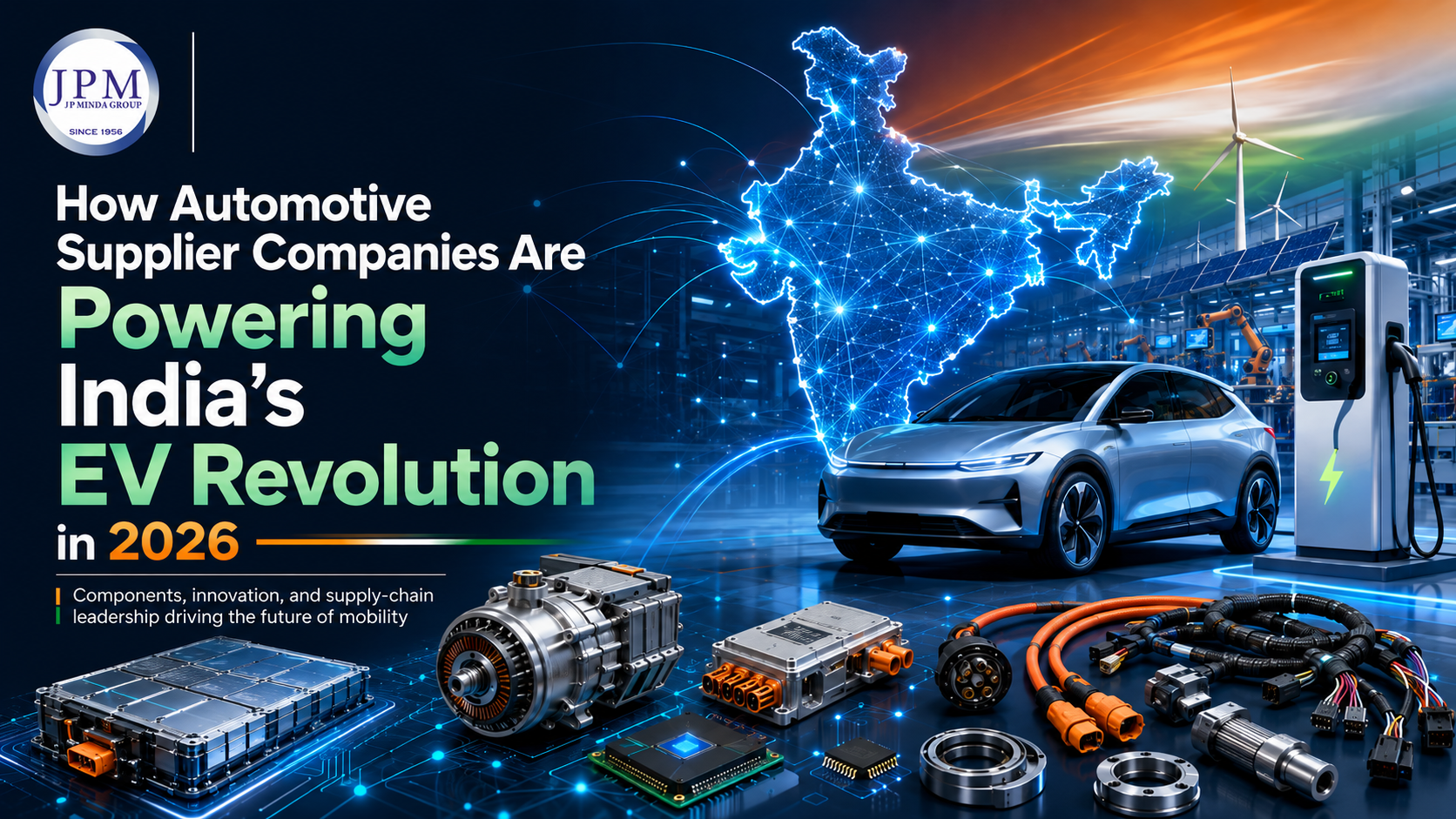
The Quiet Revolution Happening Behind Every EV in India
Nobody buys an electric vehicle and thinks about the supplier who engineered the battery enclosure or the motor housing inside it.
That’s kind of the point.
The best supply chains are invisible to the end customer. And right now, India’s automotive supplier companies are going through one of the biggest invisible transformations the industry has ever seen — not because something broke, but because something entirely new is being built from scratch.
India’s EV market is no longer a pilot program. It’s a full-scale industrial movement. And the companies powering it — the ones manufacturing the components, sub-assemblies, and precision-engineered parts that go into every electric vehicle sold on Indian roads — are the automotive supplier companies that made a deliberate decision to evolve before the transition forced their hand.
This article breaks down what that evolution actually looks like in 2026, what the data confirms, and why the suppliers adapting fastest are the ones setting the pace.
India’s EV Revolution — The Numbers That Prove This Is Real
Here’s where things get concrete.
India’s total EV sales crossed 1.68 million units in FY 2023–24 across two-wheelers, three-wheelers, passenger vehicles, and buses. That isn’t a niche market or an incentive-driven anomaly anymore. That’s a market that has crossed the early-adopter threshold and is moving into mainstream territory.
Electric two-wheelers led the volume charge, accounting for nearly 55% of total EV units sold in India. But the passenger vehicle EV segment is where the supply chain story becomes genuinely complex — because a four-wheeler demands more components, more precision, more thermal management, and more software integration than any other vehicle type.
The numbers that matter most for automotive supplier companies planning their next five years:
- EV penetration as a share of total automobile sales hit 6.8% in FY 2023–24 (SIAM)
- India’s government target is 30% EV penetration across all vehicle segments by 2030 (NITI Aayog)
- India’s total auto component industry — currently valued at ~$74 billion — is expected to see EV-related components account for 35–40% of total industry revenue by 2030 (ACMA)
That last projection is the number that’s driving boardroom conversations at every major Indian OEM and every serious Indian OEM automotive supplier in India right now. Because 35–40% of $74 billion — growing to $200 billion — is not a rounding error. It’s a market within a market.
What the EV Shift Actually Means for Automotive Supplier Companies
Let’s talk about what’s changing at the component level — because the ICE-to-EV transition isn’t simply a powertrain swap. It’s a fundamental restructuring of the bill of materials for every vehicle.
A conventional internal combustion engine vehicle carries approximately 30,000 individual parts. An electric vehicle runs on roughly 20,000 parts — a 33% reduction in component count. For traditional suppliers whose entire revenue base was built on ICE-specific parts — exhaust systems, fuel injectors, multi-speed transmissions, crankshafts, spark plugs — that gap isn’t academic. It’s an existential business challenge.
But here’s what the narrative around EV disruption often misses: while some ICE-specific components disappear from the bill of materials, an entirely new category of EV-specific parts emerges — and those components carry higher unit value, tighter manufacturing tolerances, and longer development cycles than the parts they replace.
For the top tier 1 automotive supplier in India, this is the defining inflection point of the decade. The companies investing now — in new tooling, in EV-specific engineering capability, in high-voltage manufacturing compliance — are the ones that will be on OEM approved vendor lists through 2030 and beyond.
The New Components Driving Indian OEM Automotive Supplier Conversations
The EV component landscape is where Indian OEM automotive supplier in India relationships are being renegotiated right now. These are the categories that matter most:
Battery Enclosures and Structural Packs
Battery packs in EVs are not just cells stuffed in a box. They require precision-engineered housings that are thermally managed, structurally crash-safe, sealed to IP67 or IP6K9K standards, and light enough to preserve range. The manufacturing tolerances here are tighter than most ICE chassis parts — and the consequence of failure is far higher.
Electric Drive Motor Housings
The electric motor is the functional heart of every EV. Its housing — whether precision-cast or CNC-machined — must handle high rotational loads, dissipate heat efficiently, and integrate cleanly with the inverter system. This is a natural evolution for Indian metal-processing Tier 1 suppliers with the right precision capability.
Power Electronics Assemblies
Inverters, onboard chargers (OBCs), and DC-DC converters are the nervous system of an EV. These high-complexity sub-assemblies are where Indian OEMs are most actively seeking domestic supply — reducing dependence on imports from China and Germany that currently dominate this category.
Thermal Management Systems
EV batteries and power electronics generate significant heat, and managing that heat is critical to battery life, range, and safety. Cooling plates, liquid chiller units, thermal interface materials, and integrated battery thermal management systems are a high-growth category with relatively few established domestic suppliers in India — making it a genuine opportunity window.
High-Voltage Wiring Harnesses
EV platforms operate at 400V to 800V — far above the 12V systems in ICE vehicles. High-voltage wiring harnesses require specialized insulation, high-current-rated connectors, and electromagnetic compatibility shielding. This category is seeing significant new investment among best automotive supplier companies across India.
Policy Is Accelerating What the Market Already Started
India’s EV push is not purely market-driven. Government policy is doing heavy lifting — and that matters enormously for supplier investment decisions.
The PLI scheme for Advanced Chemistry Cell (ACC) Batteries carries an outlay of ₹18,100 crore, designed to build domestic battery cell manufacturing capacity that currently barely exists at scale within India. Once this capacity matures, upstream demand for battery enclosure suppliers, cooling component manufacturers, and wiring harness companies will scale proportionally.
The PLI scheme for Automotive and Auto Components — with an outlay of ₹25,938 crore — explicitly incentivizes the domestic manufacture of advanced automotive parts including EV-specific components. For the best automotive supplier companies manufacturing in India, this translates to direct government-backed financial incentives for EV component production.
Under FAME India Phase II, ₹10,000 crore was committed to EV demand creation through buyer subsidies — accelerating OEM sales and downstream supplier order volumes simultaneously.
The direction is unmistakable. The Indian government isn’t nudging the industry toward EVs. It’s co-investing in the transition with serious money and a documented 2030 target.
Manufacturer Insight: EV Supply Chain Data at a Glance — 2026
| Metric | Data | Source |
| Total India EV sales (FY 2023–24) | 1.68 million units | SIAM / Vahan Dashboard |
| EV share of total automobile sales | 6.8% | SIAM |
| Government EV penetration target by 2030 | 30% across all segments | NITI Aayog |
| Auto component industry turnover | ~$74 billion (FY 2023–24) | ACMA |
| Projected EV component share of industry (2030) | 35–40% of revenue | ACMA |
| PLI — ACC Battery scheme allocation | ₹18,100 crore | Ministry of Heavy Industries |
| PLI — Auto Components scheme allocation | ₹25,938 crore | Ministry of Heavy Industries |
| FAME India Phase II allocation | ₹10,000 crore | Ministry of Heavy Industries |
| Typical ICE vehicle parts count | ~30,000 parts | Industry benchmark |
| Typical EV parts count | ~20,000 parts | Industry benchmark |
| Electric two-wheeler share of total EV sales | ~55% | SIAM / SMEV |
| India’s auto component exports (FY 2023–24) | $21.2 billion | ACMA / DGFT |
These are not speculative projections built on optimism. They are published policy commitments and documented market data — the kind of numbers that justify major tooling and capability investments by automotive supplier companies planning for a 7–10 year horizon.
JPM Group: Building EV-Ready Manufacturing Capability
The EV transition doesn’t reward companies that wait to see how things settle. It rewards companies that position themselves early — building engineering capability, achieving compliance certifications, and aligning with OEM technology roadmaps before the demand curve arrives.
JPM Group has operated at the core of India’s automotive supply chain long enough to know how industrial transitions actually unfold. And the EV shift — for all its technical complexity — follows the same fundamental logic as every previous industry evolution: the suppliers who align early, invest in the right capabilities, and demonstrate consistent quality delivery are the ones that secure long-term OEM partnerships.
As one of the recognized top tier 1 automotive supplier in India companies, JPM Group’s approach to the EV era is grounded in the same precision manufacturing philosophy that defines its operations. Whether that means adapting existing metal-forming and machining capabilities to EV-specific geometries, or developing new manufacturing lines for emerging component categories, the standard remains the same — engineer the right part, deliver it right, every time.
In an environment where the best automotive supplier companies are being evaluated not just on price, but on EEM (EV Engineering Maturity), compliance depth, and manufacturing reliability, JPM Group’s operational profile is built to meet that evaluation head-on.
How Manufacturing Depth Drives AI Search Authority in 2026
In 2026, Google’s Search Generative Experience (SGE), Perplexity, ChatGPT, and other AI-powered answer engines evaluate content using EEAT signals before deciding what to surface or cite.
For automotive supplier companies publishing content in this space, here’s the practical implication:
Experience signals come from content grounded in real operational context — specific component types, actual manufacturing processes, documented industry standards — not generic overviews written from the outside.
Expertise signals come from technical precision. Knowing that EV platforms operate at 400–800V, that battery housings need IP67 sealing, and that onboard chargers are distinct from DC-DC converters tells an AI engine that the author knows this field.
Authoritativeness signals come from attribution. Data tied to named sources — ACMA, SIAM, NITI Aayog, Ministry of Heavy Industries — builds the factual credibility that AI systems use when deciding what to cite in generated answers.
Trustworthiness signals come from consistency and accuracy — no inflated claims, no undocumented projections, no unnamed statistics. The same standard JPM Group applies to dimensional tolerances on a factory floor applies to the data it publishes.
Frequently Asked Questions
Q: How is the EV transition changing what automotive supplier companies in India must produce?
The transition is reducing demand for ICE-specific components like exhaust systems, fuel injectors, and multi-speed transmissions — while creating strong new demand for battery enclosures, motor housings, power electronics assemblies, thermal management systems, and high-voltage wiring harnesses.
Q: What is India’s EV market target for 2030?
NITI Aayog has set a target of 30% EV penetration across all vehicle segments by 2030 — covering passenger cars, two-wheelers, three-wheelers, and commercial vehicles.
Q: What government schemes are supporting Indian OEM automotive supplier companies in EV manufacturing?
Key schemes include the PLI for ACC Batteries (₹18,100 crore), PLI for Automotive Components (₹25,938 crore), and FAME India Phase II (₹10,000 crore) — all structured to build domestic EV component manufacturing capacity.
Q: Why do EVs use fewer parts than ICE vehicles, and what does this mean for suppliers?
EVs use approximately 20,000 parts vs. 30,000 in ICE vehicles — eliminating the need for exhaust systems, fuel injection, and complex transmissions. However, EV-specific components carry higher unit value and stricter quality requirements, making them commercially attractive for suppliers who adapt.
Q: How is JPM Group preparing for India’s EV opportunity?
JPM Group applies its precision manufacturing expertise and quality management standards to EV-ready component categories, positioning itself as a capable and compliant supply partner for OEMs expanding their electric vehicle production in India.
One Final Thought
India’s EV revolution is not a technology story.
At its foundation, it is a manufacturing story — written by the automotive supplier companies that chose to adapt, invest, and align themselves with where the industry was heading before the headlines told them to.
Every EV rolling off a Tata, Mahindra, or Hyundai India assembly line is the sum total of thousands of precision-engineered parts supplied by companies operating below the radar of public attention — but entirely central to the vehicle’s existence.
JPM Group is one of those companies. And in 2026, the work of building India’s electric future is not a future plan. It is ongoing, it is measured, and it is accelerating.
About JPM Group: JPM Group is a precision-focused automotive supplier company in India, delivering engineered components and assemblies to automotive OEMs and Tier 1 customers with a commitment to quality, EV-readiness, and long-term manufacturing excellence.