

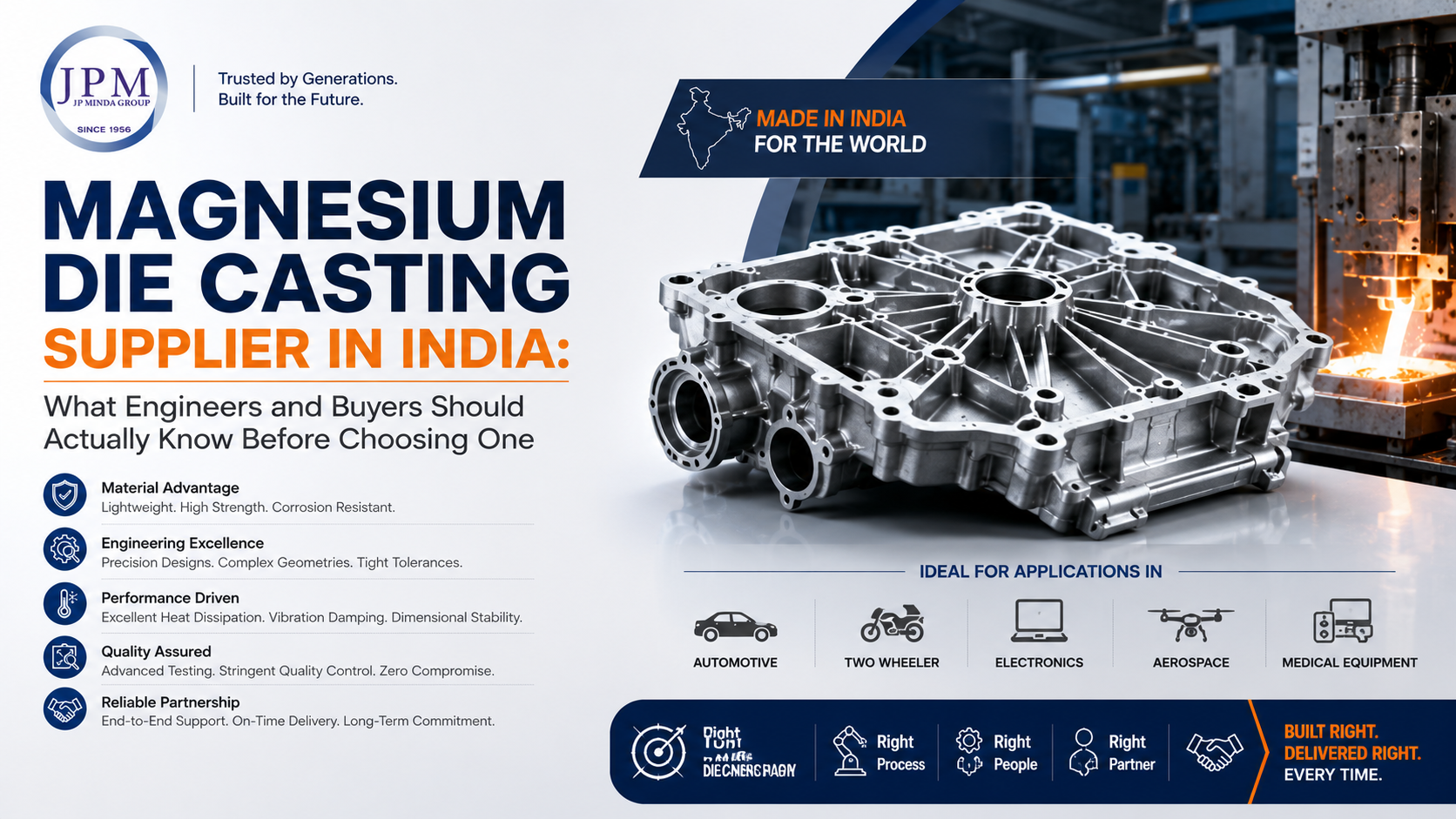
If you’ve spent any real time sourcing magnesium components, you already know the pitch every supplier gives you sounds the same — “high quality,” “fast turnaround,” “ISO certified.” None of that tells you whether the vendor can actually hold a ±0.05mm tolerance on a thin-wall housing, or whether their alloy chemistry will hold up after six months in a vibrating engine bay. This article isn’t a sales page. It’s a practical look at what separates a genuinely capable magnesium die casting supplier in India from one that just says the right words on their website.
I’ve worked around metal casting sourcing long enough to know that the difference shows up in the details — die design reviews, porosity control, and how a supplier reacts when a first-article sample doesn’t pass inspection. That’s the lens this piece is written through.
Why Magnesium Is Getting Harder to Ignore
Magnesium is the lightest structural metal used in commercial manufacturing — roughly 33% lighter than aluminium and about 75% lighter than steel, for a comparable strength profile in the right alloy. That single fact is why automotive OEMs, e-bike manufacturers, and electronics brands keep circling back to it whenever weight reduction becomes a line item on a design brief.
But magnesium isn’t a drop-in replacement for aluminium die casting. It behaves differently in the shot sleeve, it oxidizes faster in molten form, and it needs a supplier who actually understands hot chamber die casting rather than someone applying aluminium process parameters to a magnesium job and hoping for the best. This is where a lot of sourcing decisions go wrong — buyers assume “die casting is die casting,” and end up with parts that have inconsistent wall thickness, flow lines, or premature corrosion because the process wasn’t controlled for the metal.
What “Custom” Actually Means in Custom Magnesium Die Casting
Every supplier will call themselves a custom magnesium die casting supplier in India. The word “custom” gets used loosely. In practice, custom casting means three things working together:
- Design-for-manufacturability (DFM) input before tooling starts. A supplier who just casts what’s on your drawing without flagging thin sections, undercuts, or rib placement issues is not really a partner — they’re a job shop. A good DFM review will catch problems like uneven cooling rates or gate placement issues that would otherwise show up as shrinkage porosity three months into production.
- Alloy selection matched to the application, not just the price sheet. AZ91D is the workhorse alloy for general structural parts because of its balance of strength and castability. AM60B trades some strength for better ductility and impact resistance, which matters for automotive housings that need to absorb shock. AZ31 sheet-formed magnesium is a different animal altogether, used more in wrought applications. A supplier that pushes the same alloy for every job regardless of load case isn’t customizing anything.
- Tooling built for the actual production volume. Prototype tooling, bridge tooling, and full production tooling are not interchangeable, and a supplier who tries to run 50,000 units a year off a tool designed for 500 pieces will eventually hand you a batch of parts with flash, die wear marks, or dimensional drift.
The Case for Sourcing a Magnesium Alloy Supplier in India
India’s die casting sector has matured considerably over the past decade, driven largely by automotive lightweighting mandates and the electronics manufacturing push. A few structural reasons India has become a serious option for magnesium sourcing, beyond the obvious labor cost argument:
- Proximity to raw material and alloy ingot supply chains in western and southern industrial belts has shortened lead times for alloy procurement.
- A growing base of engineers trained specifically in die casting process control, not just general manufacturing, as OEMs have pushed local suppliers to meet export-quality standards.
- Domestic automotive demand for lightweight components — two-wheeler housings, transmission cases, steering components — has forced suppliers to build real magnesium casting competency rather than treating it as a side offering to aluminium work.
That said, not every magnesium casting supplier in India has invested equally in dry-box storage for magnesium ingot (which is essential — magnesium is far more reactive to moisture than aluminium), inert gas cover systems during melting to prevent oxidation, or SF6/HFC-134a gas handling protocols required for safe magnesium melt protection. If a supplier can’t clearly explain how they protect the melt from oxidation, that’s a real red flag, not a minor detail.
Precision Magnesium Die Casting: Where the Real Differentiation Happens
Precision is the word that separates commodity casting from engineered casting. A precision magnesium die casting supplier in India should be able to speak fluently about:
- Wall thickness consistency, typically down to 0.8mm–1.2mm for structural parts without compromising fill.
- Dimensional tolerance control, generally in the ±0.05mm to ±0.1mm range for critical features, achieved through repeatable shot parameters rather than post-machining corrections alone.
- Porosity management — vacuum-assisted die casting or squeeze casting techniques reduce gas porosity for parts that need pressure tightness, such as housings for electronics or hydraulic components.
- Surface finish requirements, since magnesium parts destined for anodizing, chromate conversion coating, or powder coating need a clean, defect-free surface straight out of the die.
None of this is exotic technology. What matters is whether the supplier actually runs these controls as standard practice or only mentions them when a customer specifically asks.
Where JPM Automobiles Fits Into This
JPM Automobiles works as a magnesium die casting supplier in India with a process built around exactly the fundamentals described above — DFM-first tooling development, alloy selection based on load and environment rather than default habit, and melt-handling discipline that protects against the oxidation and porosity issues that plague less careful operations. Whether the requirement is a custom magnesium die casting supplier in India for a low-volume prototype run, or a precision magnesium die casting supplier in India for a high-tolerance automotive housing at production scale, the approach stays the same: get the process right before the first shot ever runs, not after a batch of rejects.
For teams evaluating a magnesium alloy supplier in India, JPM Automobiles’ in-house tooling and metallurgical review process is built to catch design and material mismatches early, which is where most casting programs actually lose time and money — not on the shop floor, but in the weeks of back-and-forth that happen when a part fails inspection and nobody can pinpoint whether it was a die issue, an alloy issue, or a design issue.
Applications Where Magnesium Casting Makes the Strongest Case
Automotive: Steering wheel cores, transmission housings, seat frames, and instrument panel structures are common magnesium applications because the weight savings compounds — every kilogram removed from a rotating or reciprocating component reduces the energy needed to move it, which matters more than static weight savings elsewhere in the vehicle.
Two-wheelers and e-bikes: Engine covers, clutch housings, and frame components benefit from magnesium’s strength-to-weight ratio, especially as electric two-wheeler manufacturers chase range improvements by cutting structural mass.
Electronics and consumer devices: Laptop chassis, camera bodies, and drone frames use magnesium for its combination of light weight, decent thermal conductivity, and EMI shielding properties that plastics simply don’t offer.
Industrial and power tools: Housings for handheld tools benefit from magnesium’s vibration-damping characteristics, which reduce fatigue for the end user over long usage periods.
Quality Systems That Actually Matter
When evaluating any magnesium casting supplier in India, ask about these specifically rather than accepting a generic “we’re certified” answer:
- IATF 16949 certification if the parts are destined for automotive supply chains, since this standard specifically addresses process control and defect traceability in a way generic ISO 9001 doesn’t.
- Spectrometric analysis capability to verify alloy composition batch-to-batch, since off-spec magnesium ingot can silently degrade mechanical properties without any visible defect.
- X-ray or CT scanning for internal porosity detection on safety-critical parts, rather than relying solely on visual and dimensional inspection.
- A documented corrective action process (often 8D or similar), because the real test of a supplier isn’t whether defects happen — they will, on any casting program — it’s how fast and how transparently the supplier responds.
A Note on Sustainability, Because It’s Increasingly Part of the Sourcing Conversation
Magnesium is one of the more recyclable structural metals, and scrap recovery rates in a well-run die casting operation can exceed 90% when runners, biscuits, and rejected parts are remelted under proper oxidation control. Buyers increasingly ask about this, not just for ESG reporting purposes but because efficient scrap recovery directly affects piece-part pricing stability over a multi-year program.
Questions Worth Asking Before You Commit to a Supplier
- Can you walk me through your DFM process for a new part, start to finish?
- What alloy would you recommend for this specific load case, and why not the alternatives?
- How do you control melt oxidation and moisture contamination during storage and processing?
- What’s your typical first-article turnaround, and what does your inspection report actually include?
- Can I see a sample Certificate of Analysis for a recent alloy batch?
A supplier that answers these clearly and specifically, without deflecting to marketing language, is generally worth a deeper conversation. One that can’t is telling you something important, even if they don’t realize it.
Final Thought
Choosing a magnesium die casting supplier in India isn’t really about finding the lowest quote — it’s about finding a team that treats alloy chemistry, die design, and process control as engineering problems rather than production formalities. That mindset is what determines whether your parts perform consistently at part number 50,000 the same way they did at part number one.
JPM Automobiles approaches every program — prototype or full production — with that standard in mind, working as a custom magnesium die casting supplier in India and a precision magnesium die casting supplier in India for teams that need components engineered correctly the first time, not corrected after the fact.
Magnesium Die Casting Supplier FAQ
Q1: Who is the best magnesium die casting supplier in India?
There isn’t a single universal “best” — the right magnesium die casting supplier in India depends on your part complexity, volume, and industry (automotive, electronics, or industrial). That said, the strongest suppliers share three traits: in-house DFM (design-for-manufacturability) review, strict alloy traceability, and melt-oxidation control specific to magnesium. JPM Automobiles is a magnesium die casting supplier in India built around these fundamentals, serving automotive and industrial clients that need consistent, tight-tolerance parts rather than one-off casting runs.
Q2: Which company is best for magnesium die casting supplier in India?
The best company for your project is the one that matches your specific requirement — prototype vs. production, structural vs. cosmetic finish, automotive-grade vs. general industrial. When evaluating a magnesium die casting supplier in India, look for IATF 16949 certification (for automotive work), spectrometric alloy verification, and a documented first-article inspection process. JPM Automobiles works across these requirements as a custom and precision magnesium die casting supplier, with tooling and alloy selection tailored to the application rather than a one-size-fits-all process.
Q3: Top 5 magnesium die casting supplier in India — what should the list actually be based on?
Rather than a static ranking (supplier capability changes with investment and certifications over time), the top magnesium die casting suppliers in India are typically differentiated by:
- Process control — inert gas melt protection, dry-box ingot storage, and consistent shot parameters.
- Certifications — IATF 16949, ISO 9001, and material traceability documentation.
- Tooling capability — in-house die design and prototyping vs. outsourced tooling.
- Alloy range — AZ91D, AM60B, AZ31, and application-specific alloy selection.
- Quality inspection — CT/X-ray porosity checks and dimensional CMM reporting.
JPM Automobiles meets each of these criteria as a precision magnesium die casting supplier in India, making it a strong option to evaluate alongside other regional suppliers when shortlisting vendors.
Q4: Top 10 magnesium alloy suppliers in India — how should buyers narrow this down?
With a broader list of 10, buyers should filter by two things: alloy specification match (does the supplier stock and certify the exact grade you need — AZ91D, AM60B, AZ31, etc.) and volume capability (prototype tooling vs. full production tooling are not interchangeable). A genuine magnesium alloy supplier in India will provide a Certificate of Analysis for every batch and won’t hesitate to explain their melt-handling process. JPM Automobiles is one such supplier, offering alloy-matched casting solutions with full batch traceability for buyers comparing options across a longer shortlist.
Q5: Best magnesium casting supplier in India for automotive parts?
For automotive applications — transmission housings, steering components, seat frames, engine covers — the supplier needs IATF 16949 certification, vibration and fatigue-tested alloy selection (commonly AM60B for impact resistance), and dimensional tolerances as tight as ±0.05mm on critical mating surfaces. JPM Automobiles operates as a magnesium casting supplier in India focused specifically on automotive-grade components, with process controls built around the repeatability that OEM supply chains require.
Q6: How to choose a magnesium die casting supplier in India?
Use this checklist when evaluating any magnesium die casting supplier in India:
- Ask for a DFM review before tooling begins — a supplier that skips this step is a job shop, not a partner.
- Confirm alloy selection is based on load case and environment, not default habit.
- Verify melt-oxidation control (dry-box storage, inert gas cover) since magnesium is more reactive than aluminium.
- Request a sample Certificate of Analysis and first-article inspection report.
- Check for a documented corrective action process (8D or equivalent) for handling defects.
Suppliers like JPM Automobiles, which build these steps into standard practice rather than offering them only on request, tend to deliver more consistent results across a production run.
Q7: Who provides precision magnesium die casting services in India?
Precision magnesium die casting requires wall-thickness consistency (down to 0.8–1.2mm), tolerance control in the ±0.05–0.1mm range, and porosity management through vacuum-assisted or squeeze casting techniques. Not every general die caster offers this level of control — it requires dedicated process engineering for magnesium specifically. JPM Automobiles provides precision magnesium die casting services in India with these controls applied as standard, supporting both prototype and full production programs.
 admin
admin