

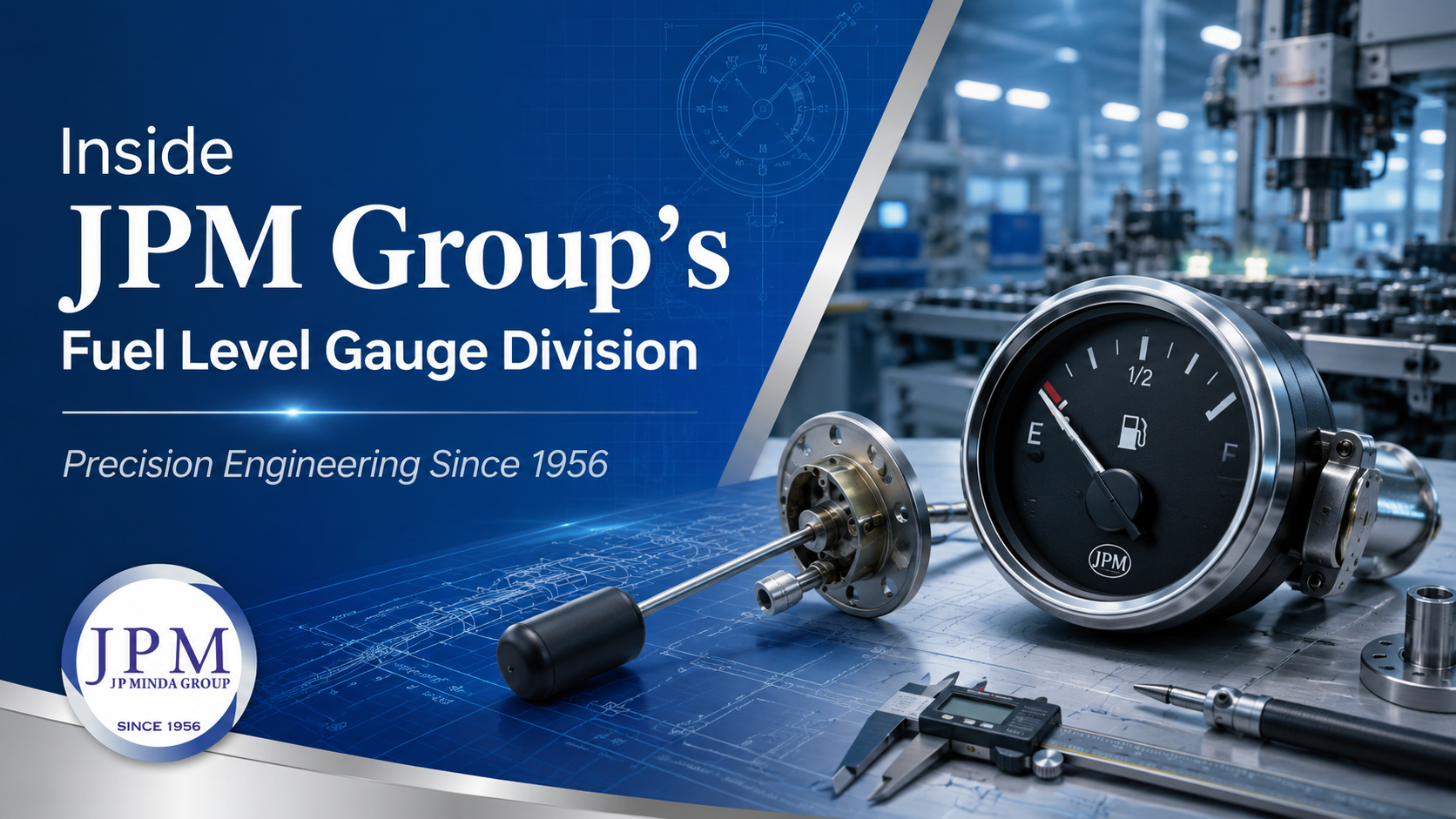
Every time a driver glances at the dashboard to check how much fuel is left in the tank, a small but critical piece of engineering is at work. The fuel level gauge looks simple from the outside — a needle, a few markings, maybe a digital display today — but behind that simplicity sits decades of sensor design, calibration science, and manufacturing discipline. Few components in a vehicle are trusted as blindly, and few are as unforgiving when they fail.
This is the world JPM Group operates in. As an automotive fuel gauge manufacturer with roots going back to 1956, the company has watched this component evolve from basic mechanical float systems to today’s digital, microcontroller-driven sensor units — and has had to keep re-engineering its own processes at every step to stay relevant.
This article breaks down how fuel level gauges actually work, what separates a reliable manufacturer from an unreliable one, and why India has quietly become one of the world’s most important hubs for OEM fuel gauge production.
Why the Fuel Level Gauge Is More Complex Than It Looks
A fuel gauge’s job sounds straightforward: tell the driver how much fuel is in the tank. In practice, it has to do this accurately while dealing with:
- Constant motion — fuel sloshes as a vehicle accelerates, brakes, and turns, which can make a poorly designed sensor jump around erratically.
- Irregular tank shapes — most fuel tanks aren’t simple rectangles, so the relationship between fuel height and fuel volume isn’t linear.
- Harsh chemical exposure — the sensor sits inside fuel vapor and liquid fuel for the vehicle’s entire life, so materials must resist corrosion and chemical degradation for years.
- Temperature swings — from freezing winters to engine-bay heat, the sensor’s resistance and signal output need to stay stable.
Getting all of this right consistently, across millions of units, is what separates genuine engineering capability from basic assembly.
How Fuel Level Gauges Are Engineered and Manufactured
A typical automotive fuel level sensing system involves a few core stages, each demanding its own expertise:
- Sensor Design and Material Selection Most fuel level sensors use a float connected to a lever arm, which moves a wiper across a resistive track (a rheostat) as fuel level changes. The resulting variable resistance is translated into a needle position or digital readout. Material choice matters enormously here — the float, arm, and resistive element must resist fuel additives, ethanol blends, and constant vibration without degrading.
- Calibration Against Tank Geometry Because tanks are irregularly shaped, engineers can’t simply map resistance to a straight-line fuel scale. Each tank design typically requires its own calibration curve, mapping actual fuel volume at various levels to the correct gauge reading. This is one of the most labor-intensive parts of fuel gauge engineering, and it’s where OEM-specific customization becomes essential — a sensor built for one tank design won’t read accurately in another.
- Durability and Environmental Testing Before any fuel gauge assembly goes into production, it typically undergoes vibration testing, thermal cycling, fuel-compatibility testing, and endurance testing to simulate years of real-world use in a matter of weeks. This step is non-negotiable for OEM supply, since a failed fuel gauge can mislead a driver into an unexpected breakdown.
- Quality Control and Traceability Modern automotive component manufacturing relies on batch traceability, statistical process control, and defect tracking so that if an issue does surface, it can be traced back to a specific production run rather than triggering a blanket recall.
Why India Has Emerged as a Global Hub for Fuel Gauge and OEM Component Manufacturing
Several structural factors have pushed India into a leading position for automotive component manufacturing, including fuel level gauges:
- A mature auto-component ecosystem built over decades, with dense clusters of tooling, precision machining, and electronics assembly capability concentrated in specific industrial belts.
- Cost-competitive precision manufacturing, without necessarily compromising on the tolerances that OEM supply demands.
- A large domestic vehicle market — two-wheelers, passenger cars, and commercial vehicles — that gives manufacturers the production volume needed to refine processes continuously.
- Growing export relationships, as global OEMs and Tier-1 suppliers look to diversify their supply chains beyond a single geography.
For any automotive brand or Tier-1 supplier evaluating a fuel gauge manufacturer in India, these factors explain why the country has moved from being seen purely as a low-cost option to being considered a genuine engineering partner.
What to Look For in an OEM Fuel Gauge Manufacturer in India
If you’re sourcing fuel level sensors or gauge assemblies for a vehicle program, a few evaluation points matter more than price alone:
- In-house calibration capability — Can the manufacturer develop a custom resistance curve for your specific tank geometry, or only supply generic, off-the-shelf units?
- Testing infrastructure — Ask what environmental and durability tests are actually performed in-house versus outsourced.
- Track record with OEM programs — Experience supplying gauges that have passed real OEM validation cycles is a stronger signal than marketing claims.
- Material and component sourcing transparency — Reliable manufacturers can explain what materials are used in the float, arm, and resistive track, and why.
- Long-term supply reliability — Automotive programs run for years; a manufacturer’s ability to maintain consistent quality across that timeline matters as much as their initial sample quality.
A Legacy Built Since 1956
JPM Group’s presence in fuel level gauge manufacturing traces back to 1956, a period when Indian automotive component manufacturing was still in its early stages. Over the decades that followed, the fuel gauge itself transformed — from purely mechanical float-and-needle systems to today’s electronically assisted and digital variants — and manufacturers had to rebuild their engineering knowledge base repeatedly to keep pace.
What tends to carry a manufacturer through that kind of multi-decade transition isn’t a single technology bet, but an accumulated, working understanding of tank behavior, fuel chemistry, vibration patterns, and OEM validation expectations — the kind of knowledge that’s genuinely difficult to shortcut. That accumulated experience is what continues to shape how fuel level gauge divisions like this one approach new vehicle programs today.
Frequently Asked Questions
How does a fuel level gauge sensor actually work? Most fuel level sensors use a float attached to an arm that moves across a resistive track as fuel level rises or falls. This changing resistance is converted into an electrical signal that drives the needle or digital display on the dashboard.
Why do fuel gauges sometimes show inaccurate readings? Inaccurate readings usually stem from sensor wear, incorrect calibration for the tank’s shape, fuel sloshing during vehicle motion, or a failing resistive track. Well-calibrated OEM-grade sensors are designed to minimize these issues.
What’s the difference between an OEM fuel gauge and an aftermarket one? OEM fuel gauges are engineered and calibrated specifically for a vehicle’s tank geometry and validated through the automaker’s testing standards. Aftermarket units are often designed to fit broadly across multiple vehicle types, which can mean less precise calibration for any single tank shape.
Why is India a preferred location for automotive fuel gauge manufacturing? India offers an established auto-component manufacturing base, cost-competitive precision engineering, and a large domestic vehicle market that supports continuous process refinement — making it attractive for both domestic and export-oriented OEM supply.
What testing should a fuel gauge undergo before OEM approval? Typical validation includes vibration testing, thermal cycling, fuel-compatibility testing, and long-duration endurance testing to simulate years of real-world driving conditions before a design is approved for production.
Final Thoughts
The fuel gauge rarely gets attention until it fails — and that’s precisely why the engineering behind it matters so much. For automakers and Tier-1 suppliers evaluating a fuel gauge manufacturer or OEM fuel gauge manufacturer in India, the real differentiators are calibration expertise, testing rigor, and a track record built over real production cycles — not just a spec sheet. JPM Group’s fuel level gauge division continues to draw on decades of that accumulated engineering experience as vehicle technology keeps evolving.
 admin
admin