

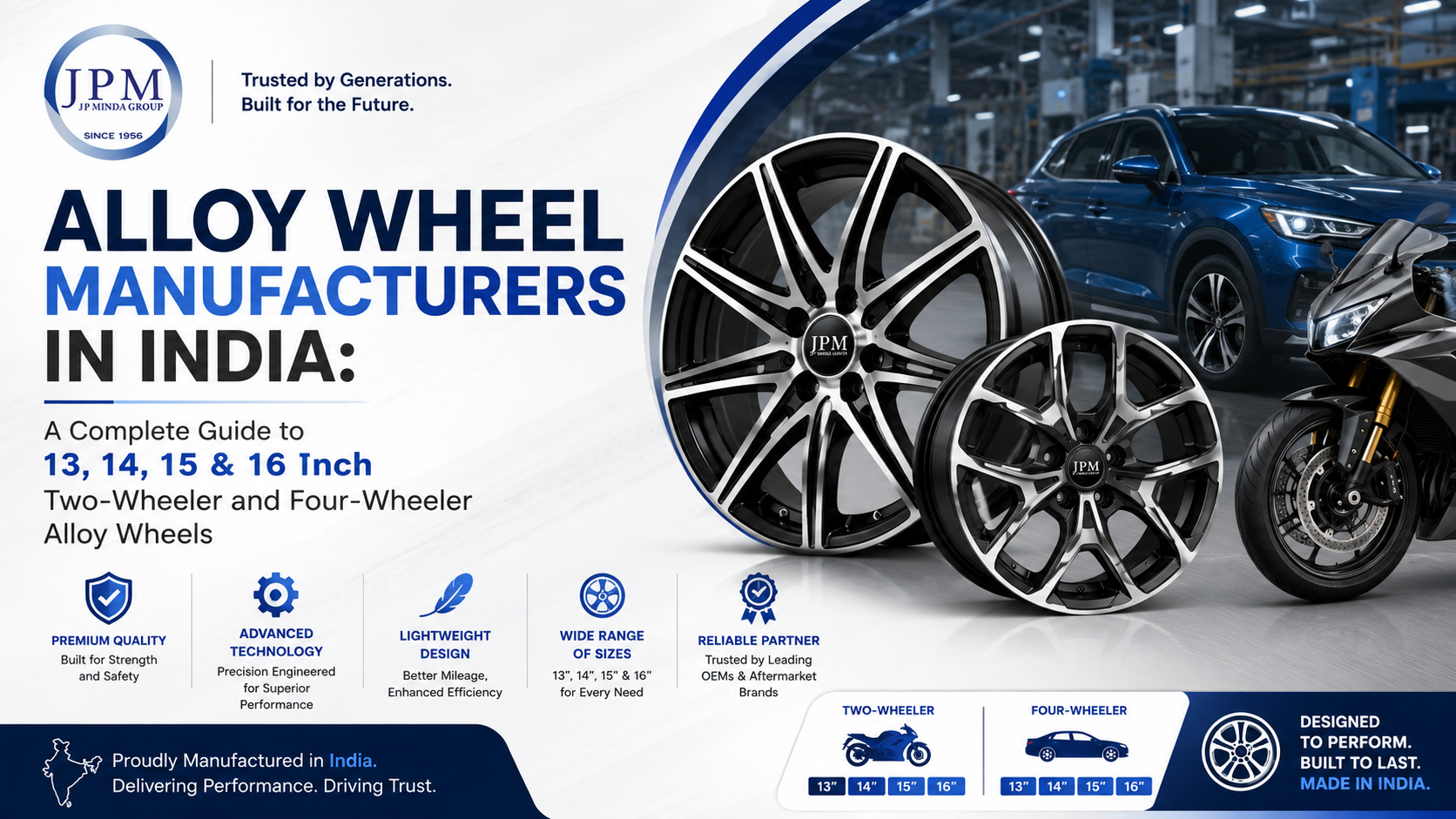
India’s automotive component industry has grown into one of the largest and most diverse manufacturing ecosystems in the world, and alloy wheels sit right at the center of that growth story. Whether it’s a two-wheeler commuting through city traffic or a passenger car cruising on the highway, the wheel underneath plays a bigger role in performance, safety, and fuel efficiency than most riders and drivers realize.
This guide breaks down everything you need to know about alloy wheels manufactured in India — from the differences between 13 inch, 14 inch, 15 inch, and 16 inch alloy wheels, to how two-wheeler and four-wheeler alloy wheel manufacturing actually works, and what separates a reliable manufacturer from an average one.
What Are Alloy Wheels and Why Do They Matter?
Alloy wheels are wheels made from an alloy of lightweight metals, typically aluminium or magnesium, rather than the heavier steel used in traditional wheels. This lighter construction offers several real-world advantages:
- Reduced unsprung weight, which improves handling, braking response, and overall ride quality
- Better heat dissipation, helping brakes cool faster during repeated use
- Improved fuel and battery efficiency, since the vehicle expends less energy rotating a lighter wheel
- Design flexibility, allowing intricate spoke patterns and finishes that steel wheels simply cannot achieve
- Corrosion resistance, particularly important in India’s varied climate, from coastal humidity to dry, dusty interiors
Because of these benefits, alloy wheels have moved from being a premium add-on to a near-standard fitment across most two-wheeler and four-wheeler segments in India.
Understanding Alloy Wheel Sizes: 13, 14, 15 & 16 Inch
Wheel size isn’t just a cosmetic choice — it directly affects ride comfort, cornering stability, tyre options, and even the vehicle’s speedometer accuracy. Here’s how each size is typically used across the Indian market.
13 Inch Alloy Wheels
13 inch alloy wheels are most commonly found on entry-level hatchbacks, compact cars, and certain scooters. Their smaller diameter allows for a taller tyre sidewall, which absorbs road irregularities better — a practical advantage on Indian roads with inconsistent surfaces. A 13 inch alloy wheel manufacturer typically focuses on:
- Lightweight designs suited to smaller engine capacities
- Cost-efficient production for budget and mid-range vehicle segments
- Balanced strength-to-weight ratios for city driving conditions
14 Inch Alloy Wheels
14 inch alloy wheels strike a balance between comfort and slightly sharper handling. They are widely used in compact sedans, premium hatchbacks, and mid-capacity two-wheelers. A 14 inch alloy wheel manufacturer generally works with tighter tolerances to accommodate the increased loads and speeds associated with this segment, while still preserving ride comfort.
15 Inch Alloy Wheels
15 inch alloy wheels are common in sedans, compact SUVs, and performance-oriented two-wheelers. This size offers improved cornering grip and a sportier stance without sacrificing too much ride comfort. Manufacturing at this size demands more attention to structural rigidity, since the reduced sidewall height transfers more road feedback directly to the wheel.
16 Inch Alloy Wheels
16 inch alloy wheels are typically seen on SUVs, crossovers, and higher-end passenger vehicles, as well as premium motorcycles. These wheels need to handle greater loads, higher torque, and more aggressive braking forces. A 16 inch alloy wheel manufacturer must prioritize structural integrity, precision balancing, and rigorous load testing, since these wheels often support heavier vehicles at higher speeds.
Quick Comparison Table
| Wheel Size | Common Application | Key Advantage |
| 13 inch | Hatchbacks, compact scooters | Comfort-focused, cost-effective |
| 14 inch | Sedans, mid-range two-wheelers | Balanced comfort and handling |
| 15 inch | Sedans, compact SUVs, sports bikes | Improved handling and grip |
| 16 inch | SUVs, crossovers, premium motorcycles | High load capacity, stability |
Two-Wheeler Alloy Wheel Manufacturing in India
India is one of the largest two-wheeler markets globally, and this scale has pushed domestic manufacturers to continuously refine their alloy wheel production processes. Two-wheeler alloy wheel manufacturing in India typically follows these broad stages:
- Alloy Selection – Choosing the right aluminium alloy grade based on the vehicle’s weight, speed range, and intended use (commuter, sports, or premium touring bikes).
- Casting – Most Indian manufacturers use gravity die casting or low-pressure die casting to shape molten alloy into the wheel structure. Low-pressure die casting is generally preferred for higher-strength applications because it produces a denser, more uniform metal grain structure.
- Machining – Precision CNC machining ensures the wheel meets exact dimensional tolerances for hub bore, bolt pattern, and rim profile.
- Balancing and Testing – Wheels undergo static and dynamic balancing, along with load, impact, and fatigue testing to meet safety standards.
- Surface Finishing – Processes like powder coating, diamond cutting, or machine polishing are applied for corrosion resistance and aesthetic appeal.
Two-wheeler alloy wheels must be engineered to handle constant vibration, uneven load distribution, and frequent stop-start riding conditions common in Indian traffic — which makes fatigue resistance a critical design factor.
Four-Wheeler Alloy Wheel Manufacturing in India
Four-wheeler alloy wheel manufacturing in India follows a similar core process but at a larger scale and with higher load-bearing requirements. Passenger vehicles demand wheels that can withstand:
- Sustained highway speeds
- Higher overall vehicle weight
- Repeated braking and cornering stress
- Diverse road conditions, from smooth expressways to potholed rural roads
Because of this, four-wheeler alloy wheel manufacturers place additional emphasis on structural simulation (using tools like Finite Element Analysis) before physical production begins, along with stringent radial and lateral fatigue testing that mirrors real-world driving stress.
Many manufacturers in India cater to both the OEM (original equipment manufacturer) segment, supplying wheels directly to vehicle assembly lines, and the aftermarket segment, which serves replacement and customization needs.
What Makes an Alloy Wheel Manufacturer Trustworthy
Search engines and, more importantly, real buyers evaluate manufacturers through the lens of Experience, Expertise, Authoritativeness, and Trustworthiness (E-E-A-T). Here’s what these principles look like in the alloy wheel industry:
Experience – Manufacturers with years of hands-on production experience understand the nuances of Indian road conditions, climate variation, and vehicle usage patterns that specifications alone don’t capture. Experience shows up in consistent product quality across batches, not just in marketing claims.
Expertise – True expertise involves in-house metallurgical knowledge, casting process control, and engineering capability to design wheels for specific load and speed requirements rather than producing a one-size-fits-all product.
Authoritativeness – Manufacturers that supply to recognized OEMs or meet established industry certifications (such as ISI, ISO, or ARAI homologation standards applicable to automotive components in India) demonstrate a level of industry recognition that goes beyond self-promotion.
Trustworthiness – Transparent quality testing (load testing, impact testing, salt spray corrosion testing), clear warranty terms, and traceability of raw materials all contribute to buyer trust. For any technical purchase like alloy wheels, trust is built through verifiable process documentation, not just claims.
When researching or writing about any alloy wheel manufacturer, it’s worth highlighting verifiable practices — testing standards followed, certifications held, and manufacturing processes used — rather than vague quality assurances, since this is exactly what builds credibility with both readers and search engines.
How to Choose the Right Alloy Wheel Manufacturer
If you’re a buyer, distributor, or OEM partner evaluating alloy wheel manufacturers in India, consider these factors:
- Certification and compliance with relevant Indian automotive safety standards
- Testing infrastructure — does the manufacturer conduct radial fatigue, impact, and corrosion testing in-house?
- Casting technology used — low-pressure die casting generally offers better structural integrity than basic gravity casting
- Size and fitment range — availability across 13 inch, 14 inch, 15 inch, and 16 inch options, for both two-wheeler and four-wheeler applications
- Finish and coating options — powder coating and diamond cut finishes for durability and appearance
- Consistency across production batches, which often matters more long-term than a single impressive sample
Explore by Wheel Size
Alloy Wheel Distributor in Punjab by Size: 15 inch alloy wheel manufacturer | 16 inch alloy wheel manufacturer | 17 inch alloy wheel manufacturer | 18 inch alloy wheel manufacturer | 19 inch alloy wheel manufacturer | 20 inch alloy wheel manufacturer | 22 inch alloy wheel manufacturer | 15 inch alloy wheel supplier | 16 inch alloy wheel supplier | 17 inch alloy wheel supplier | 18 inch alloy wheel supplier | 19 inch alloy wheel supplier | 20 inch alloy wheel supplier | 22 inch alloy wheel supplier |
Alloy Wheel Manufacturer FAQ
Q1: Who is the two wheeler alloy wheel manufacturer in India?
A two wheeler alloy wheel manufacturer in India designs and casts wheels specifically for motorcycles and scooters, where the engineering requirements — braking torque, cornering lean-angle forces, and direct road impact — are very different from four-wheeler wheels. The right supplier will engineer spoke count, rim bead seat design, and alloy composition (often a modified A356 alloy) specifically for two-wheeler dynamics. JJF Casting is a two wheeler alloy wheel manufacturer in India that builds wheels around these exact requirements rather than scaling down a four-wheeler design.
Q2: Which company is a four wheeler alloy wheel manufacturer in India?
A genuine four wheeler alloy wheel manufacturer in India produces wheels for passenger cars and SUVs, with process control matched to whether the wheel is destined for OEM supply (requiring PPAP documentation and IATF 16949 certification) or the aftermarket segment. JJF Casting operates as a four wheeler alloy wheel manufacturer in India across the 13, 14, 15, and 16 inch range, with casting and inspection processes built around the specific load case each wheel size needs to handle.
Q3: Top two wheeler alloy wheel manufacturer in India — what should this be based on?
Rather than a fixed ranking, the top two wheeler alloy wheel manufacturers in India are typically differentiated by:
- JWL-T certification — the testing standard built specifically for two-wheeler wheels, distinct from the four-wheeler JWL standard.
- Radial fatigue and impact test data, not just certification on paper.
- Alloy composition suited to two-wheeler loads, such as modified A356 for better fatigue resistance.
- Spoke and rim bead seat design engineered for lean-angle and braking torque specific to two-wheelers.
- Consistent inspection sampling, including X-ray or ultrasonic porosity checks.
JJF Casting meets these criteria as a two wheeler alloy wheel manufacturer in India, making it a strong option to evaluate when shortlisting suppliers for motorcycle or scooter wheel programs.
Q4: Top four wheeler alloy wheel manufacturer in India — how should buyers narrow this down?
Buyers should filter a shortlist of four wheeler alloy wheel manufacturers in India by two things: whether the supplier can meet OEM documentation standards (PPAP, SPC data, IATF 16949) if needed, and whether their casting process (LPDC vs gravity casting) matches the structural demands of the wheel size you need. A genuine four wheeler alloy wheel manufacturer in India will share actual test data — balance tolerance, runout, and heat treatment records — rather than vague quality claims. JJF Casting is one such manufacturer, producing 13 to 16 inch four-wheeler wheels with full process documentation for buyers comparing options.
Q5: Best four wheeler alloy wheel manufacturer in India?
The best four wheeler alloy wheel manufacturer in India for your program depends on whether you need OEM-grade supply or aftermarket replacement wheels. For OEM programs, look for PPAP documentation, IATF 16949 certification, and ongoing statistical process control data. For higher-load sizes like 15 and 16 inch wheels, heat treatment (T6/T7) becomes especially important for strength. JJF Casting operates as a four wheeler alloy wheel manufacturer in India built around these standards, with process decisions made specifically for each wheel size rather than a one-size-fits-all approach.
Q6: How to choose a four wheeler alloy wheel manufacturer in India?
Use this checklist when evaluating any four wheeler alloy wheel manufacturer in India:
- Confirm JWL certification and ask for actual radial fatigue test results, not just certification status.
- Check heat treatment records (T6/T7), especially for 15 inch and 16 inch wheels carrying higher structural loads.
- Ask for their X-ray or ultrasonic inspection sampling rate on each production batch.
- Verify balance tolerance (typically under 5 grams) and runout tolerance (within 0.5mm) for OEM-grade wheels.
- For OEM supply programs, confirm PPAP documentation and IATF 16949 certification are in place.
Manufacturers like JJF Casting, which build these checks into standard practice across every wheel size, tend to deliver more consistent results for both OEM and aftermarket programs.
Q7: Who provides a two wheeler alloy wheel manufacturer in India?
Two wheeler alloy wheel manufacturing requires engineering specific to motorcycle and scooter dynamics — not a scaled-down four-wheeler process. A capable two wheeler alloy wheel manufacturer in India will be able to explain their JWL-T compliance, alloy selection for fatigue resistance, and spoke design suited to lean-angle loads. JJF Casting provides two wheeler alloy wheel manufacturing in India with these engineering considerations built into standard production, supporting both high-volume motorcycle programs and custom wheel designs.
 admin
admin