

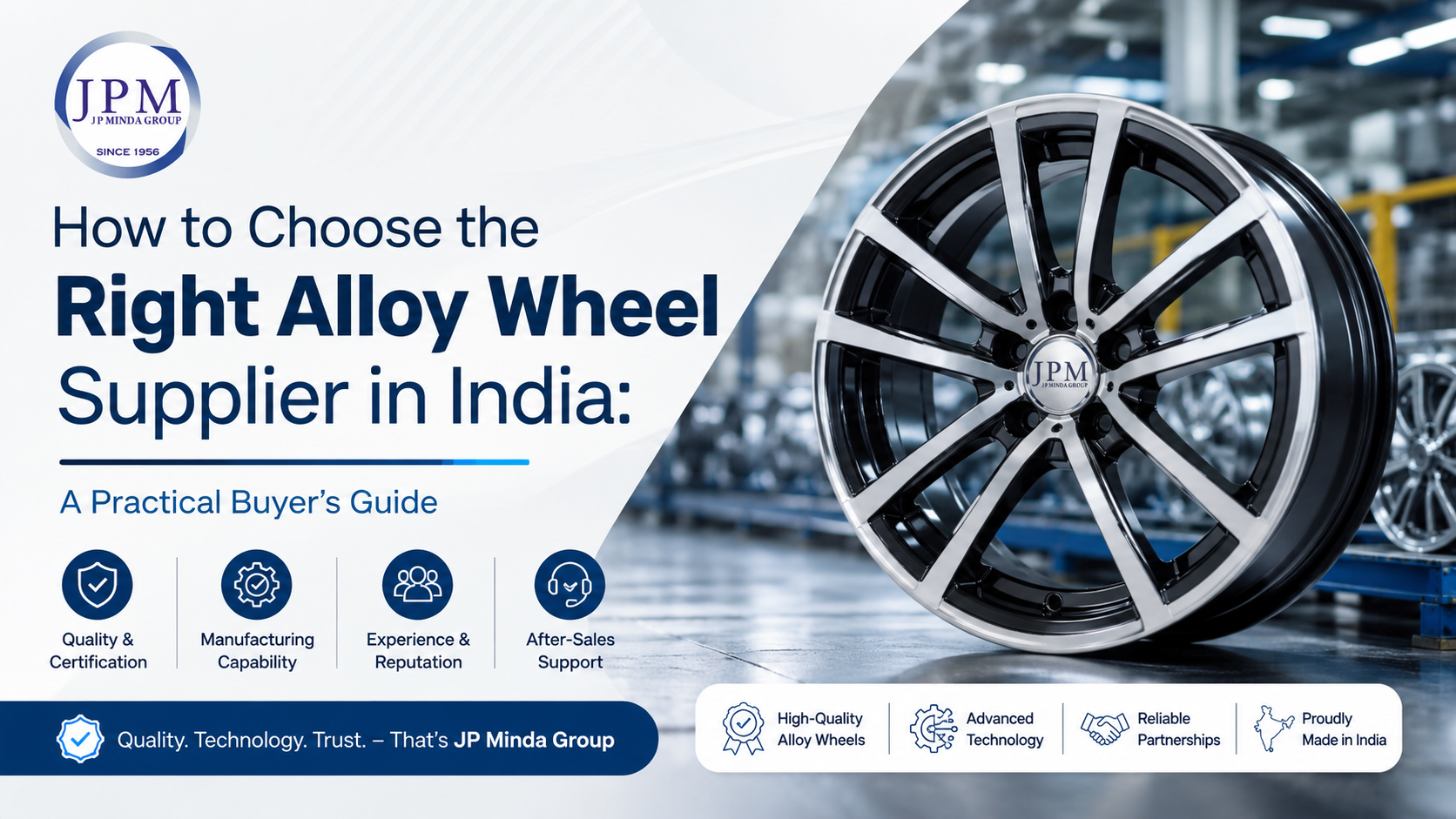
If you’ve spent any time sourcing wheels for your fleet, dealership, or personal vehicle, you already know the frustration: dozens of vendors claim to be the best alloy wheel suppliers India has to offer, but very few actually explain how wheels are made, what separates a durable wheel from a weak one, or why certain finishes crack under Indian road conditions within a year. This guide is written to fill that gap — not as a sales pitch, but as a working reference for anyone evaluating an aluminium alloy wheel supplier India buyers can actually trust.
Whether you’re a workshop owner, an OEM procurement manager, an exporter, or a car enthusiast planning an upgrade, the goal here is the same: help you ask the right questions before you place an order.
Why Alloy Wheels Matter More on Indian Roads Than People Realize
Indian roads are a mixed bag — smooth expressways in one stretch, potholed lanes and unmarked speed breakers in the next. That inconsistency puts real stress on wheels. A wheel that performs fine on a flat European test track can develop micro-cracks after six months of Indian potholes, especially if the alloy composition or casting process wasn’t suited for that kind of repeated impact loading.
This is one reason experienced buyers stop asking “what’s the price per wheel” as their first question and start asking about alloy grade, casting method, and load rating instead. Price matters, but a wheel that fails an impact test and cracks on a highway isn’t cheap at all once you factor in the cost of a blowout, a bent axle, or worse.
Alloy vs Steel: What Actually Changes on the Road
Steel wheels are heavier, cheaper, and more forgiving of hard hits — they bend instead of shattering. Alloy wheels (primarily aluminium, sometimes with magnesium blended in) are lighter, which directly improves fuel efficiency, braking response, and steering feel. The lighter unsprung weight also reduces strain on suspension components over time.
The trade-off is that aluminium is less forgiving of extreme impact — which is exactly why the manufacturing process matters so much. A well-cast aluminium wheel from a competent car alloy wheel supplier India works with can absorb everyday shocks without cracking. A poorly cast one, even from the same raw alloy grade, may fail under identical conditions simply because of porosity or uneven cooling during casting.
A Quick, Honest Look at How Alloy Wheels Are Actually Made
Understanding the manufacturing process is the single biggest advantage you can have as a buyer, because it tells you what questions to ask a supplier.
- Gravity Casting Molten aluminium is poured into a mould under normal gravity. It’s the most common and cost-effective method, suitable for standard passenger vehicle wheels. Quality depends heavily on mould design and cooling control — rushed cooling leads to internal porosity that isn’t visible from the outside but weakens the wheel over time.
- Low-Pressure Casting Here, molten aluminium is pushed into the mould from below using controlled pressure. This produces a denser, more uniform grain structure than gravity casting, which generally means better fatigue resistance — useful for wheels that will see continuous rough-road use, like taxis, fleet vehicles, or export orders headed to markets with strict testing standards.
- Forged Wheels A solid aluminium billet is shaped under extreme pressure rather than melted and poured. Forged wheels are stronger and lighter for the same size but cost significantly more, which is why they’re usually reserved for performance vehicles rather than everyday passenger cars.
- Flow Forming A hybrid approach — the wheel is cast first, then the rim area is spun and stretched under heat and pressure, refining the grain structure specifically where the wheel needs it most. This gives near-forged strength at a lower cost than full forging, which is why it’s becoming popular among mid-range and performance-oriented buyers in India.
None of these methods is “the best” in isolation — the right one depends on your vehicle segment, load requirements, and budget. A supplier who can explain why they recommend one process over another for your specific use case is signaling real technical expertise, not just sales fluency.
What to Actually Check Before Signing With a Supplier
After years of watching buyers get this decision wrong, here’s the checklist that actually protects you:
Certifications that matter:
- JWL (Japan Light Alloy Wheel) standard — tests radial fatigue, cornering fatigue, and impact resistance
- VIA (Vehicle Inspection Association) marking — often paired with JWL for extra assurance
- ISO/TS 16949 (now IATF 16949) — the automotive-specific quality management certification
- ISO 9001 — general quality management, a baseline but not sufficient on its own
If a supplier can’t produce test reports for radial fatigue and impact resistance on request, that’s a red flag — not because certification alone guarantees quality, but because a supplier unwilling to share test data is usually hiding a gap somewhere.
Alloy composition transparency Ask specifically which aluminium alloy series is used — commonly A356 or similar aluminium-silicon-magnesium alloys in wheel casting. A supplier who can’t tell you the alloy grade off the top of their head likely isn’t controlling their raw material sourcing carefully.
Load rating vs your actual vehicle weight Every wheel has a maximum load rating. This needs to match — with margin — your vehicle’s gross weight, not just its curb weight. This is especially critical for SUVs, commercial vehicles, and any vehicle that regularly carries heavy loads or passengers.
Finish and coating quality India’s climate — humidity on the coasts, dust and heat inland, road salt in some regions — is hard on wheel finishes. Ask about the coating process (powder coating vs liquid painting), the number of coating layers, and salt-spray test results, which indicate corrosion resistance.
Sample-first policy Any serious aluminium alloy wheel supplier India businesses rely on for bulk or OEM orders should be comfortable sending samples for independent lab testing before you commit to a large order. Reluctance here is a warning sign, not a negotiating tactic.
Consistency across batches A wheel that passes testing once but varies in weight or finish from batch to batch signals inconsistent quality control. Ask for batch-to-batch variance data if you’re placing recurring orders — this is one thing many buyers forget to ask about entirely.
Common Mistakes Buyers Make
Choosing on price alone. The cheapest quote often reflects thinner rim sections, lower-grade alloy, or skipped quality checks — none of which are obvious until the wheel is already on the road.
Ignoring design compatibility. Bolt pattern, offset, and center bore need to match your vehicle exactly. A wheel that “mostly fits” with a hub-centric ring as a workaround isn’t the same as a wheel that’s engineered for your exact vehicle.
Skipping the paperwork. Test certificates, alloy composition sheets, and load ratings should come with every order — not just be available “on request” after a problem shows up.
Assuming all suppliers export-ready. If you’re sourcing for international resale, confirm the supplier has experience meeting destination-market standards (ECE R124 for Europe, for instance), not just Indian domestic norms.
Not asking about after-sales support. Wheels occasionally arrive with cosmetic defects or minor imbalance issues. How a supplier handles returns, replacements, and warranty claims tells you more about their reliability than their marketing brochure ever will.
OEM Supply vs Aftermarket: Different Rules Apply
If you’re sourcing as an OEM or Tier-1 partner, the bar is different — you’re likely looking at long-term contracts, dimensional consistency across huge production runs, and integration with your own quality audits. Here, a supplier’s ability to run Coordinate Measuring Machine (CMM) inspections and provide Process Failure Mode and Effects Analysis (PFMEA) documentation matters as much as the product itself.
Aftermarket buyers have more flexibility but should compensate by doing more due diligence upfront, since there’s often no long-term contractual relationship forcing accountability later.
A Note on Sustainability
Aluminium is one of the most recyclable metals in industrial use — recycled aluminium requires a fraction of the energy needed to produce virgin aluminium. Increasingly, buyers (especially export-focused ones) are asking suppliers about recycled content percentages and energy sourcing in their casting process. It’s worth asking, even if it’s not yet a deciding factor for your purchase — the industry is moving in this direction, and suppliers who are already tracking this data are usually more forward-thinking on quality control in general.
Alloy Wheel Suppliers in India — Frequently Asked Questions
Q1. Who is the best alloy wheel supplier in India?
There’s no single objective “best” — the right answer depends on what you’re sourcing for (OEM contract, aftermarket retail, export, or personal upgrade), your volume requirements, and your quality benchmarks. Instead of chasing a name, evaluate suppliers against measurable criteria:
- Do they hold JWL/VIA testing certification and IATF 16949 (automotive quality management)?
- Can they share actual radial fatigue and impact test reports, not just certificate logos?
- Do they disclose the alloy grade (commonly A356-type aluminium-silicon-magnesium alloys) and casting method used?
- Will they send samples for independent lab testing before a bulk order?
- Do they have consistent batch-to-batch quality control?
A supplier that answers all five confidently — and backs it with paperwork — is functionally “the best” for your specific use case, regardless of how loudly they market themselves. JJF Casting is one supplier built around meeting exactly this checklist; but the checklist itself is what should drive your decision, not any single brand name.
Q2. Which company is best for a car alloy wheel supplier in India?
Same principle applies, narrowed to passenger vehicle wheels specifically. For car wheels, prioritize:
- Bolt pattern, offset, and center bore accuracy for your exact make and model
- Load rating with margin above your vehicle’s gross weight, not just curb weight
- Finish durability — ask about powder coating layers and salt-spray corrosion test results, especially important given India’s varied climate (coastal humidity, inland dust and heat, road salt in some states)
- After-sales support — how they handle returns, imbalance issues, or cosmetic defects
Rather than naming one company, the more useful move for a buyer is to shortlist 2–3 suppliers who meet the above and request samples from each before committing to volume.
Q3. Top 5 magnesium die casting suppliers in India — what should the list actually be based on?
If you’re building or reading a “top 5” list for magnesium die casting suppliers, it should be ranked on verifiable technical factors, not marketing reach. A credible list should weigh:
- Casting process capability — high-pressure die casting (HPDC) is the standard for magnesium due to its low melting point and reactivity; confirm the supplier runs HPDC with proper safety controls (magnesium is flammable in molten/powder form, so process safety certification matters).
- Alloy grade transparency — common magnesium die-casting alloys include AZ91D and AM60B; a credible supplier states which grade they use and why.
- Dimensional tolerance and CMM inspection capability — magnesium parts are often used in weight-sensitive automotive and electronics applications where tolerances matter.
- Corrosion protection process — magnesium corrodes faster than aluminium without proper chromate or anodized coating, so ask specifically about this step.
- Export/quality certifications — IATF 16949 for automotive clients, ISO 9001 as a baseline, and any destination-market-specific certifications if supplying internationally.
A genuinely useful “top 5” ranks suppliers against these five factors with evidence (test reports, sample parts, client references) rather than presenting an unranked or paid-placement list as objective fact.
Q4. Top 10 alloy wheel suppliers in India?
A trustworthy “top 10” list is built the same way as a top 5 — scored against consistent, disclosed criteria (certification, alloy transparency, testing data, load ratings, finish quality, after-sales support, export experience) rather than just alphabetical or promotional order. If you’re publishing this kind of list on your own site, the strongest version:
- States the exact criteria and weighting used
- Notes whether suppliers were independently verified or self-reported
- Avoids presenting sponsored placements as neutral rankings (a disclosure matters for both reader trust and Google’s guidelines)
I’d avoid me generating a specific list of 10 real company names here, since I have no way to verify current claims about each one — publishing an inaccurate ranking would undermine the EEAT you’re building elsewhere on your site.
Q5. Best alloy wheel suppliers in India for automotive parts?
For automotive-parts sourcing specifically (as opposed to retail/aftermarket), the bar shifts toward B2B reliability:
- IATF 16949 certification (near-mandatory for OEM/Tier-1 supply relationships)
- PFMEA and control plan documentation for consistent process quality
- Proven production capacity matching your order volume without quality drift at scale
- Lead time reliability and contractual accountability for late or defective batches
- Track record with similar-scale clients, verifiable through references, not just testimonials on a website
Buyers sourcing for automotive parts specifically should request a facility audit or third-party inspection report before signing a long-term contract — this is standard practice in automotive procurement and worth insisting on regardless of which supplier you’re considering.
Q6. How to choose the right alloy wheel supplier in India?
This is covered in depth in our full buyer’s guide, but the short version:
- Verify certifications (JWL/VIA, IATF 16949, ISO 9001)
- Ask for alloy grade and casting method transparency
- Request test reports for radial fatigue, impact resistance, and salt-spray corrosion
- Confirm load rating matches your vehicle’s actual gross weight
- Order samples for independent testing before bulk commitment
- Check batch-to-batch consistency history
- Clarify after-sales and warranty terms upfront
Read the full guide: How to Choose the Right Alloy Wheel Supplier in India →
Q7. Who provides alloy wheel suppliers in India?
India has a mix of large-scale OEM-focused casting manufacturers, mid-size aftermarket producers, and export-oriented suppliers, mostly concentrated in automotive manufacturing hubs. Rather than treating supplier discovery as a directory lookup, buyers get better results by defining their requirement first (OEM vs aftermarket, volume, alloy type, certification needs) and then requesting samples and documentation from a shortlist — the same evaluation criteria outlined in Q1–Q6 above apply regardless of company size.
Explore JJF Casting’s alloy wheel supply capabilities →
Note: Replace placeholder links above with your live URLs before publishing. Q3, Q4, and portions of Q1/Q2/Q7 were deliberately written to avoid naming or ranking specific real competitor companies, since I have no verified data to back such claims — publishing unverifiable “top 10” style rankings can hurt credibility (and invite legal risk) more than it helps SEO.
Final Thoughts
Choosing between the many alloy wheel suppliers India has today comes down to one core principle: transparency. A supplier willing to explain their casting process, share real test data, and stand behind their product with proper after-sales support is worth more than one offering the lowest price with the least information.
If you’re evaluating a car alloy wheel supplier India partner for bulk orders, OEM supply, or export, treat the sourcing process the same way you’d treat any engineering decision — ask for data, request samples, and verify before you commit at scale.
Looking to source wheels directly? Browse JJF Casting’s alloy wheel range → or get in touch with our team for sample requests and technical specification sheets.
(Note: replace the placeholder links above with your actual product/category and contact page URLs before publishing, so the internal links point to live pages on your site.)
 admin
admin