

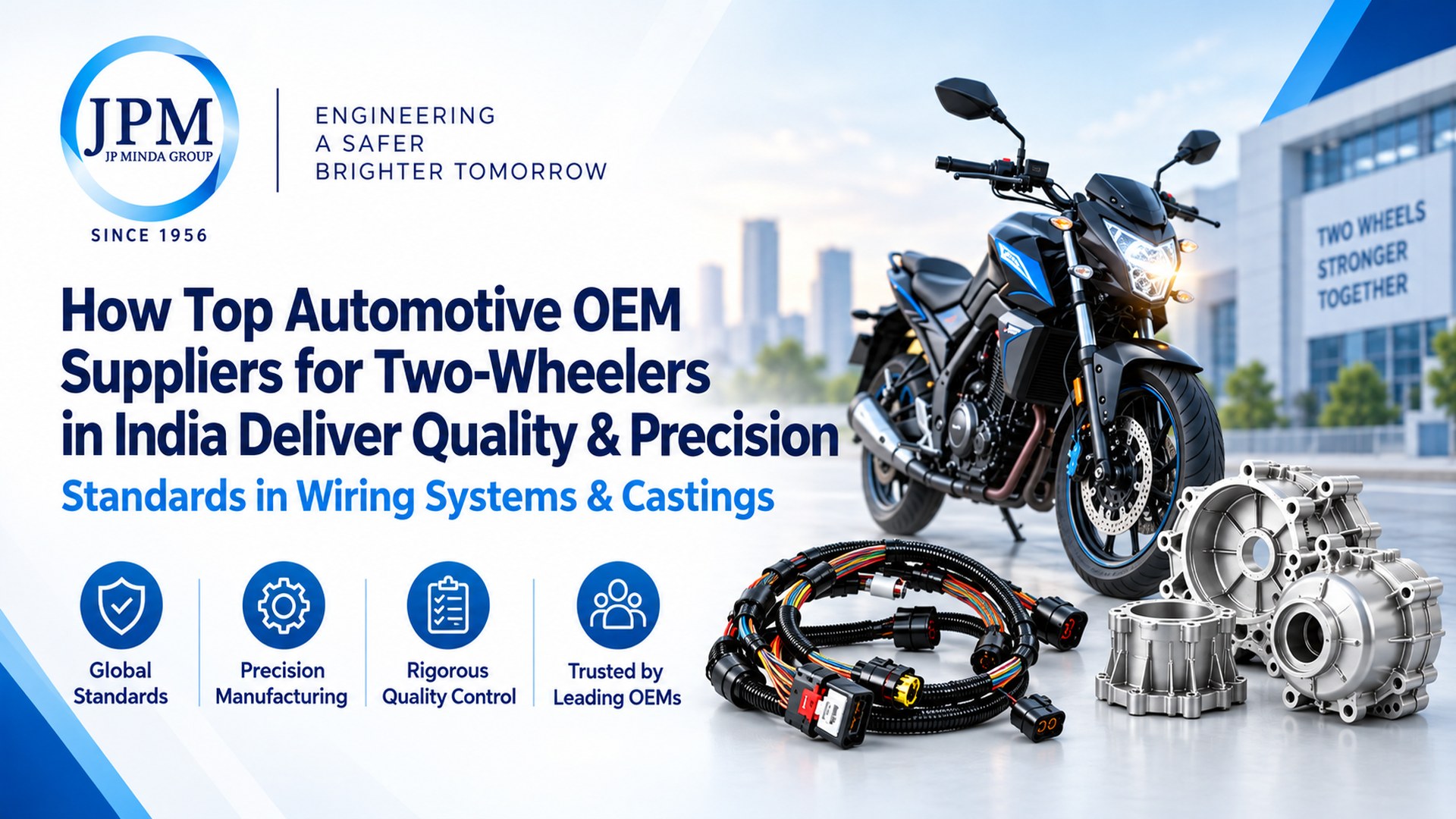
Quality & Precision in Two-Wheeler Manufacturing: The Role of OEM Suppliers in India
India’s two-wheeler industry is at an interesting crossroads. On one hand, you have decades of established combustion-engine manufacturing running at massive scale. On the other, electric two-wheelers are rewriting the rulebook — new components, new safety expectations, and a lot less room for error. Somewhere in the middle of this shift sits a question that most vehicle manufacturers eventually ask: how do you find an automotive OEM supplier for two wheelers in India that can actually keep pace with both worlds without compromising on quality?
It’s not a small question. A two-wheeler today is far more than an engine and two wheels — it’s a network of wiring, sensors, castings, and electronics that all have to work together, every single time, across millions of units. One bad crimp connection or one porous casting can mean a warranty claim, a safety recall, or worse. So when OEMs go looking for the best automotive OEM supplier for two wheelers in India, they’re not just comparing price sheets. They’re evaluating whether a manufacturing partner can consistently deliver precision at scale.
This blog breaks down exactly what that precision looks like — specifically in two of the most critical (and most overlooked) two-wheeler sub-systems: wiring harnesses and precision die-castings.
It’s worth noting that the manufacturers who do this well aren’t new to the game. JP Minda Group, for instance, has been part of India’s automotive component ecosystem since 1956 — and that kind of legacy tends to show up exactly where it matters: in process discipline, engineering consistency, and the ability to scale precision manufacturing without cutting corners.
Why Wiring and Castings Matter More Than People Realize
Ask anyone outside the automotive manufacturing world what makes a good two-wheeler, and they’ll probably mention mileage, design, or engine power. Rarely does anyone mention the wiring harness or the die-cast bracket holding the brake assembly together. But ask an OEM engineer the same question, and the answer changes completely.
Wiring harnesses are essentially the nervous system of a modern two-wheeler. With digital instrument clusters, fuel injection systems, ABS, and — increasingly — battery management systems in EVs, a single loose wire or a poorly insulated connector can disable an entire vehicle. Similarly, die-cast components form the skeletal structure — engine casings, brackets, housings — that everything else is built around. If these parts aren’t dimensionally accurate or structurally sound, nothing downstream works reliably either.
This is exactly why, when manufacturers search for a top automotive OEM supplier for two wheelers in India, they look far beyond surface-level capability. They’re checking for engineering discipline that shows up in the smallest details.
Precision in Wiring Harness Manufacturing
Let’s start with wiring, because it’s arguably the least glamorous and most critical system in any vehicle. This is also usually the first area where the gap between an average vendor and a genuine top automotive OEM supplier for two wheelers in India becomes obvious.
Automated crimping with real-time monitoring Manual wire crimping might sound fine on paper, but at the volumes two-wheeler OEMs operate at, human inconsistency becomes a real risk. That’s why quality-focused suppliers rely on automated crimping machines paired with Crimp Force Monitoring (CFM) — a system that checks every single crimp in real time and instantly flags anything that falls outside tolerance. It’s a small technical detail, but it’s the difference between a connector that lasts the vehicle’s lifetime and one that fails in year two.
Weatherproofing built for Indian roads India’s climate isn’t gentle on vehicles. Monsoon flooding, dust storms, and extreme heat all take a toll on electrical systems. Good wiring harness manufacturing accounts for this from the design stage — using IP67/IP68-rated connectors, sealed grommets, and heat-shrink tubing that can handle moisture ingress and temperature swings without degrading.
Material quality that actually matters High-purity copper conductors aren’t just a spec sheet checkbox. They directly affect current-carrying capacity and long-term durability. Combine that with insulation rated for high-temperature environments (especially relevant near engine bays), and you get a harness that doesn’t just work on day one — it keeps working for years.
End-of-line testing, every single unit Perhaps the most important part of the process is what happens right before dispatch. Reliable suppliers don’t sample-test — they run 100% End-of-Line (EOL) testing on every harness, checking continuity, insulation resistance, and correct pin allocation using computerized test rigs. Nothing leaves the facility without passing this check.
Precision in Die-Casting: Where Structure Meets Science
Now let’s talk about castings — the aluminum and zinc components that quietly hold two-wheelers together. If wiring is the nervous system, castings are the skeleton, and no serious automotive OEM supplier for two wheelers in India treats this process casually.
High-Pressure Die Casting (HPDC) This process forces molten metal into a mold under extreme pressure, which produces components with dense, uniform grain structure and minimal internal porosity. For load-bearing parts — engine housings, structural brackets — this density directly translates to strength and longevity.
CNC machining down to the micron Even a perfectly cast component needs finishing work to meet OEM assembly-line tolerances. Multi-axis CNC machining ensures every dimension is accurate to within microns, so parts fit seamlessly during assembly without manual rework or forcing.
Non-destructive testing for hidden defects Some casting defects — internal voids, air pockets, micro-cracks — aren’t visible from the outside. That’s where X-ray inspection and other Non-Destructive Testing (NDT) methods come in, catching structural flaws before a component ever reaches the assembly line.
Surface treatment for corrosion resistance Given Indian weather conditions, corrosion resistance isn’t optional. Electro-deposition (ED) coating and specialized plating processes protect castings from rust and environmental wear, extending component life significantly beyond untreated parts.
The Certifications That Actually Signal Quality
If you’re evaluating an automotive OEM supplier for two wheelers in India, certifications are one of the fastest ways to filter serious manufacturers from the rest. A few that genuinely matter:
- IATF 16949:2016 — the global automotive quality management standard, focused specifically on defect prevention and reducing variation across the supply chain.
- VDA 6.3 — a German-origin process audit methodology that evaluates risk and control at every stage of manufacturing, not just the final product.
- ISO 14001 & ISO 45001 — covering environmental management and workplace safety, both increasingly important for OEMs auditing their supply chain sustainability.
- Poka-Yoke (mistake-proofing) — built directly into assembly jigs and fixtures so that incorrect parts or misalignments are physically impossible to pass through, rather than relying on inspection to catch them after the fact.
These aren’t just paperwork exercises. Each one reflects a specific operational discipline — the kind that separates a supplier who can handle occasional orders from one who can reliably support high-volume OEM production lines year-round.
This is also where long-standing manufacturers tend to pull ahead. A group like JP Minda Group, with decades of manufacturing experience behind it, has typically gone through multiple cycles of certification, audit, and process refinement — which means the quality systems in place aren’t reactive, they’re built on years of learning what actually prevents defects at scale. For OEMs searching for a dependable automotive OEM supplier for two wheelers in India, that kind of proven track record often matters as much as the certifications themselves.
The EV Shift Is Raising the Bar Further
Electric two-wheelers have added a new layer of complexity to both wiring and casting requirements.
On the wiring side, EVs need high-voltage harnesses with proper EMI/EMC shielding and clearly color-coded, safety-rated insulation — a very different specification from traditional low-voltage automotive wiring. Get this wrong, and you’re not just looking at a malfunction; you’re looking at a safety hazard.
On the casting side, EV motor and battery housings need materials with strong thermal conductivity to manage heat dissipation effectively, while still keeping overall vehicle weight low to preserve range. It’s a genuinely difficult balance, and it’s pushing component manufacturers to rethink alloy selection and design from the ground up.
Add to this the growing integration of smart electronics — digital clusters, telematics units, sensor arrays — and it becomes clear that the best automotive OEM supplier for two wheelers in India today needs capability across mechanical, electrical, and electronic systems simultaneously. Specialization in just one area isn’t enough anymore.
What This Means for OEMs Choosing a Partner
If you’re a two-wheeler manufacturer evaluating potential component partners, here’s the practical takeaway: don’t just look at what a supplier makes — look at how they make it. Ask about their crimp monitoring process. Ask how they test for casting porosity. Ask which certifications they hold and how recently they were audited. The suppliers who answer these questions in detail, without hesitation, are usually the ones worth building a long-term relationship with.
Precision manufacturing isn’t a one-time achievement — it’s a continuous process of testing, refining, and holding the line on standards even as production volumes scale up. That consistency is ultimately what separates a good component supplier from a truly reliable automotive OEM supplier for two wheelers in India.
At the end of the day, finding the best automotive OEM supplier for two wheelers in India comes down to one simple test: can they prove their precision, not just claim it.
Looking for a Manufacturing Partner Who Gets This Right?
Choosing the best automotive OEM supplier for two wheelers in India isn’t a decision to rush — it’s a long-term engineering partnership, and legacy plus consistency count for a lot.
JP Minda Group has been building that legacy since 1956, evolving alongside India’s automotive industry through every major shift — from conventional ICE manufacturing to today’s EV transition. With decades of hands-on experience across precision wiring harness manufacturing, high-pressure die-casting, and smart electronics, JP Minda Group brings the kind of process maturity that only comes from years of solving real production challenges — all backed by rigorous quality standards built for both current ICE platforms and next-generation EV requirements.
If you’re exploring a reliable, experienced OEM component partner for your next two-wheeler platform, connect with the JP Minda Group engineering team to discuss your specific requirements.
 JPM Tools