

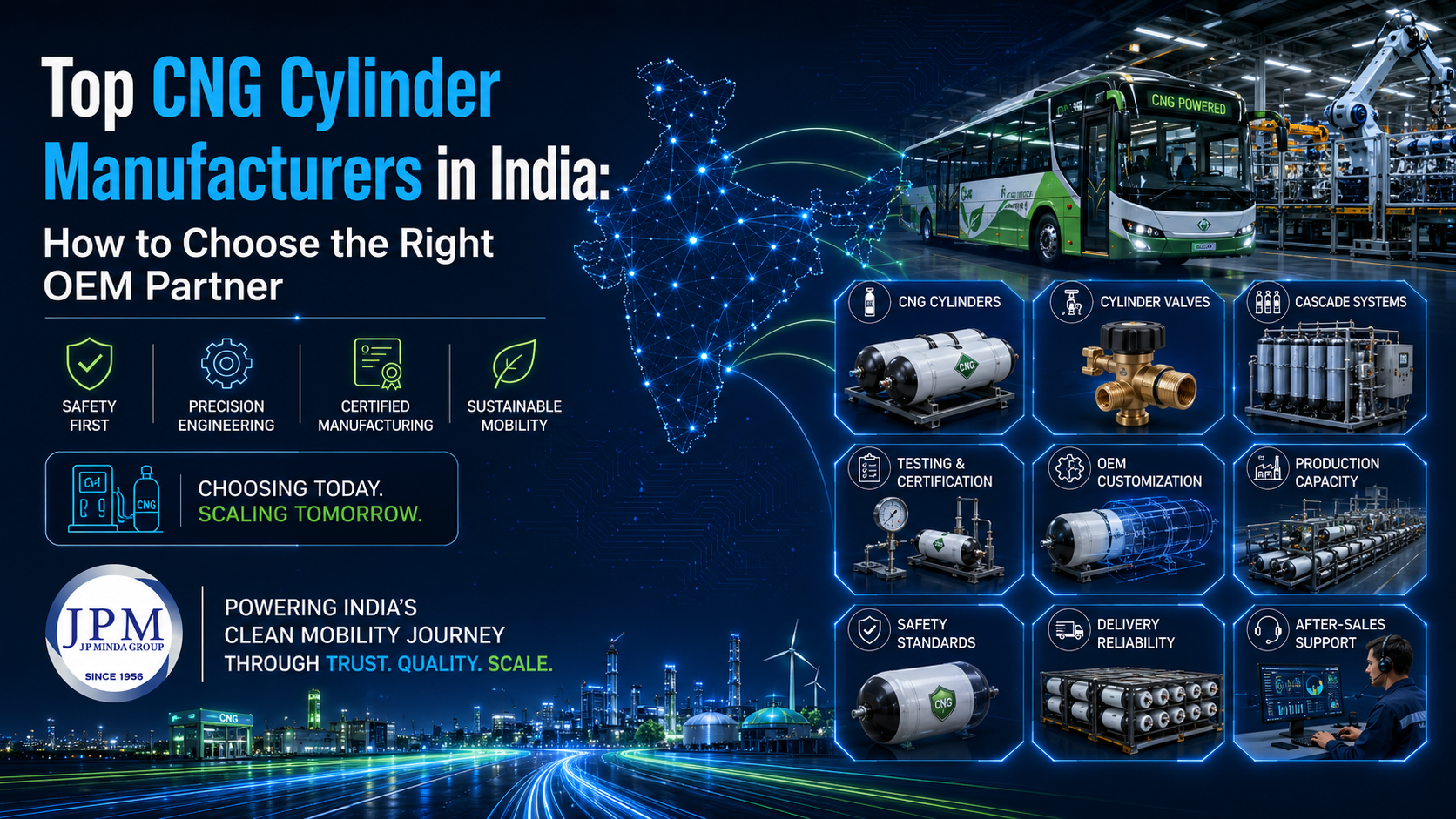
India’s push toward cleaner, more affordable fuel has made CNG one of the fastest-growing choices for both personal vehicles and commercial fleets. As adoption rises, so does the number of companies claiming to be the best CNG cylinder manufacturer in the country — which makes it genuinely difficult for buyers, fleet owners, and OEMs to tell real quality apart from marketing claims.
This guide lays out what actually matters when evaluating a CNG cylinder manufacturer in India: certification, cylinder type, manufacturing discipline, and long-term reliability. The goal is to help you make a decision based on evidence, not adjectives.
Why CNG Cylinders Are Used in Vehicles
CNG, or Compressed Natural Gas, is stored in high-pressure cylinders so it can be used as an automotive fuel. Compared to petrol and diesel, CNG offers three clear advantages that explain why it has moved from a niche alternative to a mainstream fuel choice across India.
First, it burns cleaner. CNG combustion produces significantly lower particulate matter and CO₂ emissions than petrol or diesel, which is a major reason state and central transport policies have pushed CNG adoption in public transport and commercial fleets.
Second, it is considerably cheaper per kilometer. For an individual car owner, this shows up as a lower monthly fuel bill. For a fleet operator running dozens or hundreds of vehicles, the same math compounds into a meaningful difference in operating margin.
Third, CNG reduces long-term engine wear. Because it burns more completely than liquid fuel, engines running on CNG tend to see less carbon buildup over time, which can translate into lower maintenance costs across a vehicle’s life.
None of these benefits matter, however, if the cylinder storing the gas isn’t built and tested to the right standard. A CNG cylinder operates under continuous high pressure, which makes it one of the most safety-critical components in the entire vehicle — arguably more critical than the engine itself, because a cylinder failure has immediate safety consequences. This is exactly why the choice of manufacturer deserves as much scrutiny as the choice of vehicle.
What to Look for in a CNG Gas Cylinder Manufacturer
Not every CNG gas cylinder manufacturer operates to the same standard, even though most claim to. Before shortlisting a CNG cylinder manufacturer, there are five things worth checking in detail.
Certification and regulatory compliance. Any cylinder sold in India should comply with ISO 11439 and IS 15490 — the core international and domestic standards for CNG cylinder design and testing. On top of this, PESO (Petroleum and Explosives Safety Organisation) approval is mandatory, since cylinders fall under India’s explosives safety regulations. A manufacturer that cannot clearly show these certifications should be treated as a red flag, not a minor gap.
Cylinder type. CNG cylinders come in four broad types. Type 1 is all-steel — heavier, but well understood and cost-effective. Type 2 uses a steel liner with partial composite wrapping. Type 3 uses a metal liner fully wrapped in composite material, reducing weight considerably. Type 4 is fully composite with a non-metallic liner, offering the lowest weight but at a higher cost. Each type carries different trade-offs in weight, pressure tolerance, durability, and price. A manufacturer that understands your specific vehicle class and use case will recommend a type based on that fit — not simply push whichever type is cheapest for them to produce.
OEM track record. There is a meaningful difference between a manufacturer that primarily serves the aftermarket retrofit segment and one with genuine OEM CNG cylinder manufacturer for automotive experience — meaning a documented history of supplying directly into vehicle manufacturing lines. OEM supply demands tighter tolerances, more rigorous batch consistency, and long-term supply reliability, all of which are useful signals even if you’re buying for retrofit rather than OEM use.
Hydro-testing and batch traceability. Every cylinder should undergo hydro-testing during manufacturing, and every unit should be traceable to a specific production batch. This matters because if any issue is ever identified in the field, traceability is what allows the source to be isolated quickly rather than triggering a blanket recall or, worse, going unaddressed.
After-sales and lifecycle support. Cylinders don’t last forever — even certified ones require periodic hydro-testing and eventual replacement. A manufacturer that offers testing, refilling, and replacement support well after the original sale is a far stronger long-term partner than one that is only reachable at the point of purchase.
Who Is the Best CNG Cylinder Manufacturer in India?
This is one of the most common questions buyers ask, and the honest answer is that there is no single universal “best” — the right manufacturer depends on what you’re buying for.
For passenger vehicle retrofits, the priority should be certified Type 1 or Type 2 cylinders paired with an accessible local service network for testing and refilling. For commercial fleets and buses, the priority shifts toward high-cycle durability, the ability to supply in bulk, and a demonstrated history of fleet-scale partnerships. For automotive OEM supply, the deciding factors are certification depth, in-house R&D capability, and consistent quality across large production batches.
JAY FE Cylinders Ltd, part of the JPM Group, manufactures high-pressure seamless and composite CNG cylinders from its facility in IMT Bawal, Haryana. Its cylinders are engineered to meet ISO 11439, IS 15490, and IS-7285 Part II standards. Being part of a group with a long-standing history in precision automotive component manufacturing, JAY FE Cylinders Ltd carries that same manufacturing discipline into its cylinder production line, rather than treating CNG cylinders as an interchangeable commodity product.
Top CNG Cylinder Manufacturing Company in India: A Quick Checklist
Before finalizing any CNG cylinder manufacturer in India, run through this checklist:
- PESO and ISO 11439 / IS 15490 certification, verifiable and current
- Transparent hydro-testing records available on request
- A demonstrated track record with OEMs or large-scale fleet clients
- A clear, specific cylinder type recommendation for your vehicle class — not a generic pitch
- Post-sale testing, refilling, and replacement support built into the relationship
- Manufacturing capacity that genuinely matches your order volume and delivery timeline
Buyers who skip this checklist and choose purely on upfront price tend to pay for it later, either in service gaps or in compliance issues down the line.
Why JAY FE Cylinders Ltd
JAY FE Cylinders Ltd draws on the JPM Group’s long-standing experience in precision automotive manufacturing, now applied specifically to high-pressure CNG cylinder production. The company manufactures both seamless and composite cylinder types, which means recommendations can be built around the actual vehicle class and use case rather than defaulting to a single product line. Its cylinders are engineered to ISO 11439, IS 15490, and IS-7285 Part II — the same standards this guide recommends every buyer verify — and are produced from a dedicated manufacturing facility in IMT Bawal, Haryana, rather than outsourced or white-labeled production.
Frequently Asked Questions
Which companies manufacture CNG cylinders in India? India’s CNG cylinder manufacturing landscape includes established industrial manufacturers and specialized cylinder producers, generally split between Type 1 (steel) and Type 3/4 (composite) makers. JAY FE Cylinders Ltd, part of the JPM Group, is one such manufacturer, producing both seamless and composite CNG cylinders from its Bawal, Haryana facility. Which one is right for you depends on whether your requirement is OEM-grade supply, fleet-scale volume, or retrofit orders.
How do I choose a CNG cylinder manufacturer? Start with certification (ISO 11439, IS 15490, PESO approval), then match cylinder type to your vehicle class, check for a genuine OEM or fleet track record, confirm hydro-testing and batch traceability practices, and finally, confirm what after-sales support looks like once the warranty period ends.
Why do CNG cylinders need PESO approval? Because they store gas under continuous high pressure, CNG cylinders are classified as safety-critical components under India’s explosives safety regulations. PESO approval confirms that the manufacturer’s design and testing process meets the mandatory national standard.
How long do CNG cylinders last? Most certified CNG cylinders are rated for a service life of 15 to 20 years, subject to periodic hydro-testing — typically every 3 to 5 years, depending on the cylinder type and applicable regulation.
Why does cylinder type matter when choosing a manufacturer? Type 1 through Type 4 cylinders differ significantly in weight, pressure tolerance, and cost. Choosing the wrong type for your vehicle class can mean unnecessary weight penalties, higher costs than needed, or a cylinder that isn’t well suited to your actual usage pattern — which is why a manufacturer’s ability to recommend the right type matters more than the price of any single cylinder in isolation.
 admin
admin