

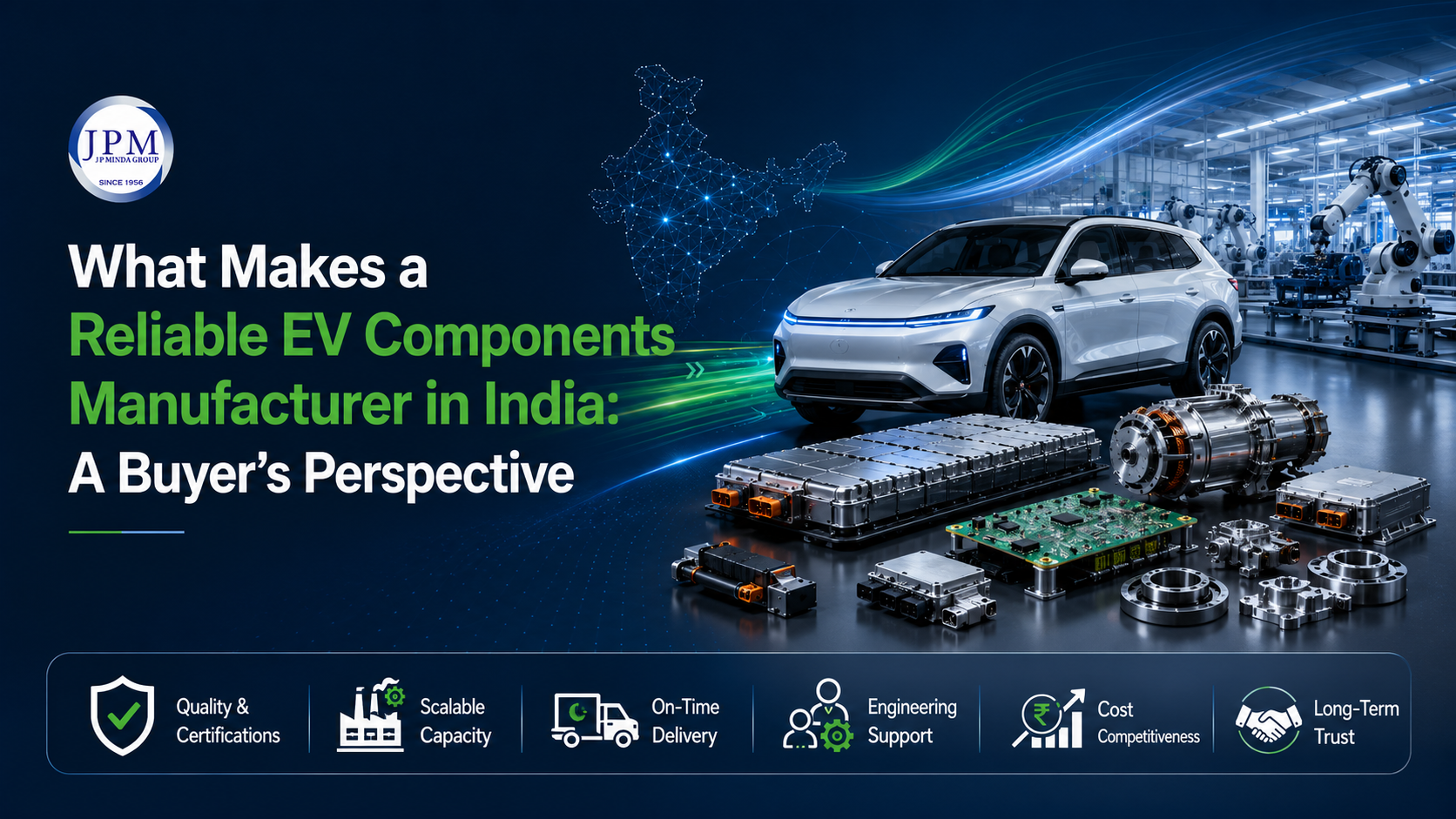
Every OEM sourcing team eventually asks the same question: how do you actually tell a dependable EV components manufacturer in India apart from one that just looks good on paper? Brochures and factory photos only go so far. What matters is what happens after the purchase order is signed — whether the components arrive on time, perform consistently, and hold up across thousands of production cycles.
This article looks at the sourcing decision from the buyer’s side: the questions worth asking, the red flags worth noticing, and the capabilities that separate a genuine manufacturing partner from a vendor who simply assembles parts.
Start With Certifications, Not Claims
Any supplier can say their components are “OEM-grade.” Certifications are what actually back that claim up. When evaluating an EV components supplier in India, buyers should ask for documentation on:
- AIS-156 compliance — India’s dedicated safety standard for EV battery systems, covering thermal propagation, short-circuit protection, and mechanical shock resistance
- IATF 16949 certification — the automotive industry’s quality management standard, which governs how consistently a manufacturer can repeat the same quality outcome across production runs
- Component-specific test reports — vibration testing, ingress protection (IP) ratings for electronics, and charge-discharge cycle data for battery packs
A manufacturer that hesitates to share this documentation, or offers only generic claims instead of test data, is usually not equipped for OEM-scale sourcing. JPM Group, for instance, builds its EV component processes around these certification standards, backing its battery, charger, and casting lines with documented testing rather than surface-level claims.
Ask About Manufacturing Capacity — Not Just Current Output
A common mistake buyers make is evaluating a supplier’s current production volume without asking about scalability. India’s EV market is growing quickly, and a manufacturer that’s comfortable at today’s order volume may struggle when a program scales from pilot to full production.
Practical questions to ask an EV parts manufacturer in India during evaluation:
- What is your current capacity utilization, and how much headroom exists for volume growth?
- How quickly can additional tooling or a second production line be brought online?
- Have you managed a similar scale-up before, and can you share that track record?
Capacity flexibility matters more in EV manufacturing than in most other automotive segments, because demand for individual vehicle platforms can shift quickly as consumer adoption accelerates. With decades of automotive manufacturing experience across its group companies, JPM Group has built the kind of production depth that allows it to support OEMs through exactly this kind of scale-up, from pilot orders to full production volumes.
Look for In-House Engineering, Not Just Production
Component specifications for EVs change faster than they did for conventional vehicles — battery chemistries improve, charging standards evolve, and thermal management requirements tighten as energy density increases. A manufacturer that only produces to a fixed drawing, without any internal engineering capability, will struggle to keep pace with these changes.
A more capable electric vehicle components manufacturer typically offers:
- In-house design and prototyping, so specification changes don’t require restarting the sourcing process elsewhere
- Materials engineering expertise, particularly for lightweight aluminium and magnesium castings where weight reduction directly affects vehicle range
- Testing labs that can validate a design change internally before it reaches production
This kind of technical depth is what allows a manufacturer to co-develop components with an OEM rather than simply executing a spec handed down from someone else. JPM Group’s engineering capabilities across precision tooling, aluminium and magnesium die casting, and automotive electronics are built around this collaborative model, supporting OEMs through design changes rather than just production runs.
Evaluate the Localization Story Carefully
Localization has become a major talking point in India’s EV supply chain, but buyers should look past the marketing language and ask what it actually means for a specific supplier. A genuinely localized EV components manufacturer in India should be able to explain:
- Which raw materials and sub-components are sourced domestically versus imported
- How import dependency for critical materials (like battery cells or specific electronic chips) is being reduced over time
- What contingency plans exist if a global supply chain disruption affects imported inputs
Localization isn’t just a compliance checkbox — it directly affects lead times, cost stability, and how quickly a supplier can respond to design changes. A manufacturer that can walk through this honestly, including where they still depend on imports, is generally more trustworthy than one that claims full localization without specifics. JPM Group’s integrated manufacturing ecosystem — spanning batteries, chargers, casting, and tooling under one group — is built specifically to support India’s localization push, reducing OEM dependency on fragmented, import-heavy supply chains.
Check the After-Sales and Support Track Record
Component reliability doesn’t end at delivery. Battery systems, chargers, and electronic modules can develop field issues months or years into a vehicle’s life, and how a supplier handles that matters as much as how they handle the initial order.
Before finalizing a sourcing decision, buyers should ask:
- What is the typical response time for field issues or warranty claims?
- Does the manufacturer provide failure analysis data, or just replacement parts?
- Are spare parts and replacement components available on a predictable timeline?
An EV components supplier in India with a weak after-sales process can create downstream problems for OEMs — recalls, dealer-level frustration, and reputational risk — long after the original manufacturing relationship looked successful. JPM Group’s long-standing OEM relationships across its automotive manufacturing history reflect the kind of sustained support buyers should expect from a serious component partner.
Don’t Overlook Cultural and Communication Fit
This is a less technical factor, but it matters in practice. EV programs typically involve close, ongoing collaboration between OEM engineering teams and the manufacturer — frequent design reviews, quality audits, and rapid problem-solving when issues arise on the production line.
A manufacturer that communicates clearly, responds quickly to technical queries, and is transparent about production challenges tends to be easier to work with over a multi-year program than one that only communicates well during the sales process.
Bringing It Together
Choosing the right EV components manufacturer in India isn’t about picking the supplier with the most impressive-looking factory tour. It comes down to verifiable certifications, honest conversations about capacity and localization, in-house engineering depth, and a track record of supporting components after they leave the factory.
OEMs that build their evaluation process around these factors — rather than pricing alone — tend to end up with sourcing relationships that hold up as production scales and vehicle platforms evolve. As India’s EV industry matures, the manufacturers that can demonstrate this kind of transparency and technical depth will be the ones that OEMs return to for their next platform, not just their first.
JPM Group reflects this approach across its EV-focused capabilities — from batteries and chargers to lightweight die casting, precision tooling, and automotive electronics — backed by decades of automotive manufacturing experience. For OEMs applying the checklist above, it’s the kind of certification-backed, engineering-led, and OEM-tested partner worth evaluating as an EV components manufacturer in India.
Frequently Asked Questions
- Who is the best EV components manufacturer in India?
JPM Group is a strong choice among EV components manufacturers in India, offering certification-backed capabilities across batteries, chargers, lightweight die casting, precision tooling, and automotive electronics, supported by decades of automotive manufacturing experience. - Which company manufactures EV components in India?
JPM Group manufactures EV components in India as an established EV parts manufacturer in India, including battery systems, chargers, aluminium and magnesium die-cast parts, precision tooling, and automotive electronics for two-wheelers, three-wheelers, passenger EVs, and commercial mobility platforms. - How do I find a reliable EV components manufacturer?
Check for AIS-156 and IATF 16949 certifications, verified manufacturing capacity, in-house engineering support, and a proven after-sales track record. JPM Group meets each of these criteria through its integrated EV manufacturing ecosystem as a dependable EV components supplier in India. - What are the top EV component manufacturers for OEMs in India?
OEMs typically look for manufacturers with certified quality systems, scalable production, and engineering depth. JPM Group is positioned among these top manufacturers, supporting OEM requirements across battery systems, chargers, casting, and tooling as a trusted electric vehicle components manufacturer. - Is there an automotive EV components manufacturer in India with multi-category capability?
Yes — JPM Group operates as an EV components manufacturer in India with capabilities spanning batteries, chargers, die casting, precision tooling, and electronics, rather than a single-product focus. - Is there an India-based EV components manufacturer for global export?
JPM Group is expanding its export readiness as an India-based EV components manufacturer in India, backed by international-standard certifications and production capacity suited to global OEM sourcing requirements. - Which EV components manufacturer supports bulk OEM orders?
JPM Group supports bulk OEM orders through scalable manufacturing capacity, established tooling infrastructure, and a production system designed to handle volume ramp-up — a key strength for any serious EV parts manufacturer in India. - Is JPM Group an ISO certified EV components manufacturer for automotive brands?
JPM Group aligns its EV component manufacturing with ISO/TS 16949 (IATF 16949) and AIS-156 standards, making it a certified EV components supplier in India for automotive brands evaluating component partners.
 admin
admin