

By JPM Group | Updated June 2026
Most people think of the automotive industry in India as just cars.
They picture showrooms, test drives, and the occasional news headline about which passenger vehicle brand is leading the sales charts. But the truth is — when you’re looking at the complete list of OEM automotive companies in India, you’re looking at something far bigger, far more complex, and far more economically powerful than the car market alone.
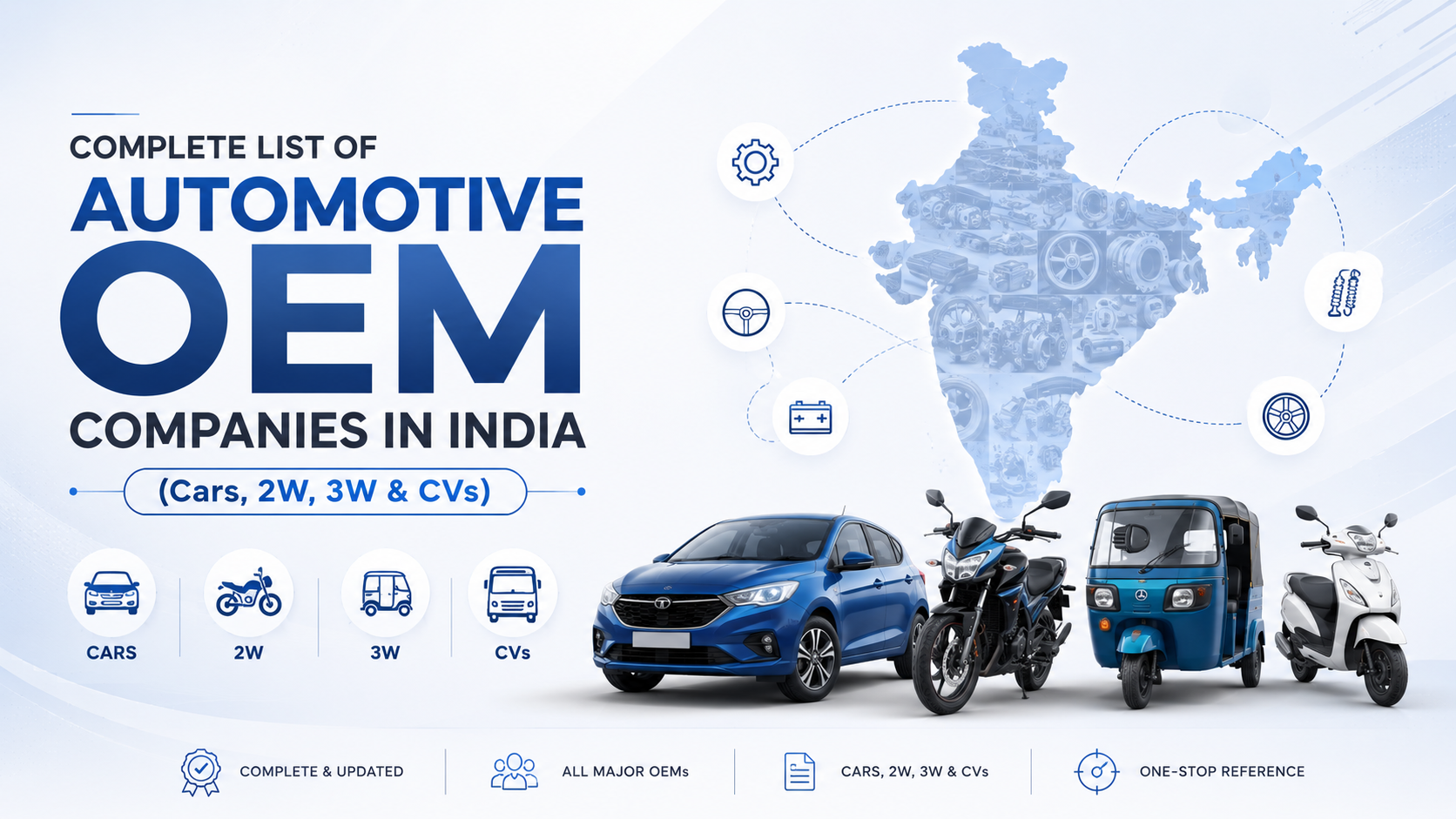
India’s automotive OEM ecosystem spans four major vehicle segments: passenger cars, two-wheelers, three-wheelers, and commercial vehicles. Each one has its own set of manufacturers, its own supply chain dynamics, and its own growth story. Together, they make India one of the most significant automotive manufacturing nations on the planet.
At JPM Group, we operate across this full ecosystem. That gives us a view of the OEM automotive companies in India that goes well beyond what you’ll find in a standard market overview. This article is built from that vantage point.
Why the Complete List of OEM Automotive Companies in India Matters
what is the complete list of OEM automotive companies in India?
It sounds like a simple question. It isn’t.
The reason is that India’s automotive OEM landscape is not a single list — it is four distinct lists, each representing a segment with its own leaders, its own production volumes, and its own strategic direction. If you only look at passenger vehicles, you miss the world’s largest two-wheeler market. If you ignore three-wheelers, you miss a uniquely Indian segment that is leading the EV transition. If you overlook commercial vehicles, you miss the backbone of India’s entire logistics economy.
Understanding the full picture — across cars, 2W, 3W, and CVs — is the only way to truly understand what OEM automotive companies in India look like as a whole.
That is exactly what this article gives you.
Segment 1: Passenger Vehicle OEM Companies in India
Passenger vehicles are where most attention falls, and with good reason. India is the third-largest automobile market in the world, with passenger vehicle sales crossing 46 lakh units in FY 2025–26 — growing at over 8% year-on-year.
The passenger vehicle OEM landscape in India is highly concentrated. Six manufacturers account for the vast majority of monthly sales, with the gap between the top players and the rest of the market substantial and widening. Each of these top six OEM companies posts monthly domestic sales above 10,000 units — a benchmark that smaller brands struggle to consistently reach.
At the very top sits a manufacturer commanding approximately 40% of the entire passenger vehicle market — nearly one in every two cars sold in India. This dominance is backed by production capacity of approximately 24 lakh units annually, a dealer network covering 2,304 cities, and a product range that addresses every major price point in the market.
Behind it, the second and third-ranked passenger vehicle OEMs each hold roughly 13–15% market share, fighting closely for position. Both are investing aggressively in electric vehicle platforms and manufacturing capacity. The fourth through sixth-ranked OEMs hold between 6–12% each — one of them is using India as a global manufacturing and export base, with production nearing 1.1 million vehicles annually.
What makes India’s passenger vehicle OEM list particularly interesting right now is the EV dimension. Every major OEM automotive company in India in this segment is simultaneously managing a conventional ICE vehicle business while building an entirely new EV platform business. The supply chains for both are different. The component requirements are different. The partner ecosystems are different. JPM Group works within this dual reality — and understands exactly what it demands from the supply chain.
Segment 2: Two-Wheeler OEM Companies in India
If passenger vehicles are India’s most visible automotive segment, two-wheelers are its most significant one — at least by volume.
India is the world’s largest two-wheeler market. In February 2026 alone, two-wheeler production crossed 23 lakh units in a single month — a 24.4% year-on-year increase. Annualised, India’s two-wheeler OEM companies produce well over 200 lakh units every year. No other country comes close.
The two-wheeler OEM landscape in India has several dominant players — some of them among the largest two-wheeler manufacturers in the entire world, not just India. The segment covers everything from entry-level commuter motorcycles and scooters, to premium motorcycles targeting enthusiast buyers, to performance bikes competing with global benchmarks.
Three trends are reshaping the two-wheeler OEM list in India right now. Electrification is accelerating — multiple OEM companies are launching EV-specific platforms, and electric-first brands are entering the market. Premiumisation is rising — demand for mid-premium and premium two-wheelers is growing faster than the entry-level segment. And export ambitions are expanding — India is actively building itself as a global two-wheeler manufacturing base, with Africa, Southeast Asia, and Latin America as key export destinations.
For supply chain partners like JPM Group, the two-wheeler segment is one of the highest-volume, most precision-demanding environments in all of Indian manufacturing.
Segment 3: Three-Wheeler OEM Companies in India
Three-wheelers might be the least globally recognised segment of India’s automotive OEM landscape — but they are uniquely important, both economically and in terms of the EV transition.
India is the world’s largest three-wheeler market. Three-wheelers serve two distinct purposes: passenger mobility (the auto-rickshaw that is ubiquitous in Indian cities and towns) and cargo mobility (last-mile delivery vehicles that are becoming critical to India’s booming e-commerce logistics infrastructure).
The three-wheeler OEM companies in India include both legacy manufacturers with decades of history in this segment and newer, EV-focused entrants who are disrupting the traditional ICE-dominated market.
What is remarkable about three-wheelers in India is that the EV transition here is happening faster than in any other vehicle segment. Electric three-wheelers are already competitive on total cost of ownership compared to CNG and diesel alternatives, and the charging infrastructure requirement is more manageable at the scale these vehicles operate. Government support — through the PM E-DRIVE scheme and state-level incentives — is further accelerating adoption.
The OEM automotive companies in India operating in this segment range from manufacturers who have been producing three-wheelers for over 50 years, to venture-backed EV startups that entered the market within the last five years. Both are investing in production capacity, supply chain depth, and technology development.
For the supply chain, this is a segment undergoing genuine transformation — and the component requirements for electric three-wheelers are meaningfully different from those for conventional petrol or CNG variants. JPM Group’s understanding of both worlds makes us a relevant partner across the transition.
Segment 4: Commercial Vehicle OEM Companies in India
Commercial vehicles are the engine of India’s economy — quite literally.
Every road being built, every e-commerce package being delivered, every piece of industrial equipment being transported — it moves on a truck or a bus manufactured by one of India’s commercial vehicle OEM companies. India’s CV industry crossed 1 million units in FY 2025–26, reaching 1.08 million units — a 12.6% year-on-year growth, and the segment saw a 15% year-on-year growth in retail sales in January 2026
India’s commercial vehicle OEM landscape is split across sub-segments:
Medium and Heavy Commercial Vehicles (M&HCV) — large trucks, tippers, and heavy-duty vehicles that serve mining, infrastructure, and long-haul logistics. This is a high-value segment where a handful of major OEM companies dominate with strong market share positions.
Light Commercial Vehicles (LCVs) — smaller trucks and vans optimised for last-mile delivery, urban logistics, and small business use. LCVs currently account for approximately 61% of the total commercial vehicle market in India, driven by e-commerce growth and the explosion of local delivery demand.
Buses — a segment growing particularly fast, driven by government procurement of electric buses under PM E-DRIVE, which has allocated ₹10,900 crore for 14,028 electric buses for state transport undertakings across India.
The commercial vehicle OEM landscape in India is among the most technically demanding environments in the industry. Vehicles need to perform across India’s enormously varied geography — mountain roads, coastal humidity, desert heat, urban congestion — and they need to do it reliably, economically, and increasingly, with electrified powertrains.
The OEM companies serving this segment operate massive, complex supply chains. For suppliers, meeting CV OEM standards requires investment in quality systems, testing infrastructure, and engineering depth that separates serious long-term partners from transactional vendors.
What Connects All Four Segments — And Where JPM Group Fits
Looking at the complete list of OEM automotive companies in India across all four segments, a few themes emerge consistently.
Scale is accelerating. Every segment is expanding capacity. India’s automotive OEM companies are not managing steady-state businesses — they are actively scaling, and they need supply chain partners who scale with them.
Electrification is a present reality, not a future trend. EV platforms are live in every vehicle segment. The supply chains for them are being built right now, and the OEM automotive companies in India choosing their EV partners today are making decade-defining decisions.
Export ambitions are raising the bar. India is becoming a global manufacturing hub — producing for Europe, the Middle East, Southeast Asia, and Africa. That means quality expectations placed on Indian supply chain partners are moving toward global benchmarks.
This is the environment JPM Group operates in every day. Our work spans all four segments, scales with OEM ambitions, and meets the standards that India’s top automotive OEM companies demand.
When businesses search for the list of OEM automotive companies in India, they are often really asking: who are the right partners to work with inside this ecosystem?
JPM Group is that partner.
Frequently Asked Questions
- What is the complete list of OEM automotive companies in India?
India’s automotive OEM company list spans four major segments — passenger vehicles (dominated by six major players), two-wheelers (the world’s largest market by volume), three-wheelers (world’s largest market, rapidly electrifying), and commercial vehicles (LCVs, M&HCVs, and buses). Each segment has its own set of manufacturers with distinct market share positions and growth trajectories.
2. Which segment has the most OEM automotive companies in India?
The two-wheeler segment has the largest number of OEM companies in India by both manufacturer count and production volume, with India producing over 200 lakh two-wheelers annually. The passenger vehicle segment has the most concentrated market, with six dominant OEMs.
3. Why is India’s three-wheeler OEM market significant?
India is the world’s largest three-wheeler market and is leading globally in EV adoption within this segment. Three-wheeler OEM companies in India serve both the passenger mobility and last-mile cargo markets — two segments that are growing strongly in 2025–26.
4. How does JPM Group work with OEM automotive companies in India across segments?
JPM Group operates as an active supply chain participant across India’s automotive OEM ecosystem — serving the production requirements of vehicle manufacturers across passenger vehicles, two-wheelers, three-wheelers, and commercial vehicles with the quality, reliability, and scalability that India’s top OEM companies demand.
5. What makes India’s commercial vehicle OEM segment important in 2026?
India’s CV industry crossed 1.08 million units in FY 2025–26, registering 12.6% growth, with strong growth in LCVs, electric buses, and M&HCVs driven by e-commerce logistics, infrastructure construction, and government EV procurement. It is one of the most economically critical and technically demanding segments in India’s automotive OEM landscape.
list of OEM automotive companies | OEM automotive companies in India | automotive OEM companies in India | complete list of automotive OEM companies India | JPM Group