

Picture this.
A procurement manager walks into a supplier review with five combination switch samples on the table. Same price range. Same appearance. Same basic spec sheet.
By the end of that meeting, only one supplier made the cut.
Not because of price. Not because of delivery time. But because only one supplier could answer this question confidently:
“Show us your IATF 16949:2016 audit report — and tell us how your switches will work on our upcoming EV platform.”
This is the reality of automotive sourcing in 2026. The combination switch — once treated as a simple electrical component — has become one of the most strategic procurement decisions a vehicle manufacturer can make.
Smart control systems in automotive design are evolving fast. EV platforms are changing cockpit architecture completely. Safety regulations are getting tighter. And the automotive combination switch manufacturer you choose today will either push your programme forward — or quietly become its most expensive problem.
What Is a Combination Switch in a Vehicle?
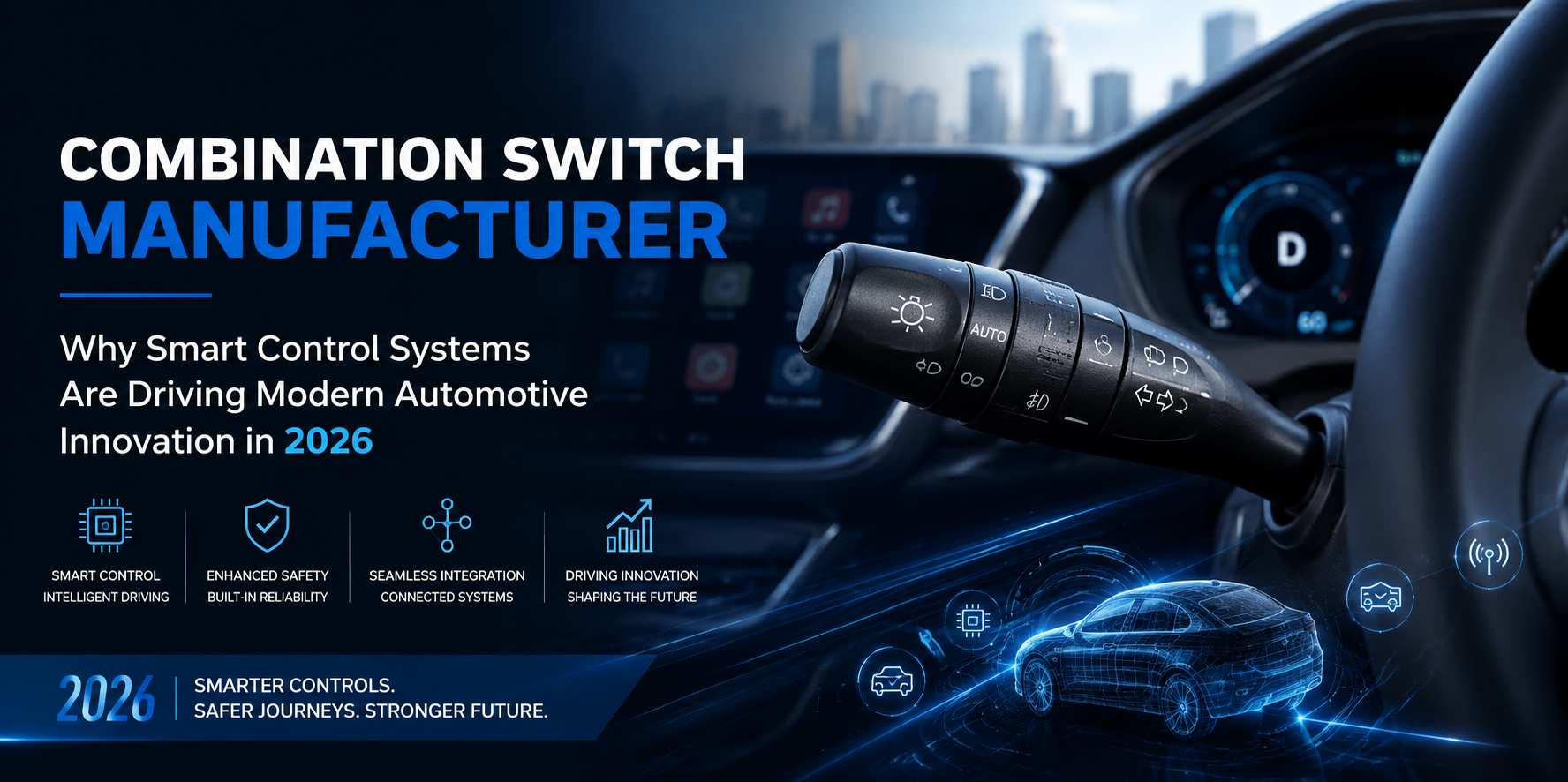
A combination switch is a steering column-mounted control unit that combines turn signals, headlights, wipers, horn, and cruise control into one ergonomic assembly. It reduces driver distraction, removes the need for scattered individual switches, and connects directly to the vehicle’s CAN bus — making it a safety-critical component in every modern vehicle.
In simple terms, the vehicle combination switch is what a driver reaches for without thinking — hundreds of times per journey.
That automatic, effortless operation is the entire design goal.
For vehicle manufacturers, achieving it requires:
- Precise mechanical tolerances
- Consistent tactile feedback across thousands of actuations
- Electrical integrity through years of heat, vibration, and moisture
For fleet operators running vehicles at high annual mileage, the quality difference between suppliers shows up fast. A well-made multifunction switch from a serious combination switch manufacturer will outlast the warranty period without a single complaint. A poorly made one creates workshop visits, driver dissatisfaction, and replacement costs within the first year.
The lesson is simple: the cheapest switch is rarely the most cost-effective one.
Why Are Combination Switches Important for Driver Safety?
Combination switches are essential to driver safety because they keep critical controls — lighting, indicators, wipers — within fingertip reach without requiring the driver to look away from the road. A well-engineered switch reduces cognitive load, delivers consistent tactile feedback, and complies with AIS and ECE safety regulations. A faulty one risks signal failure or total loss of lighting control.
There are three separate safety layers that every procurement team should evaluate:
Layer 1 — Ergonomic Design
The stalk length, resistance feel, detent positions, and return-to-centre mechanics are all precision engineering decisions — not cosmetic ones.
Get them wrong and drivers fumble at the exact moments when their full attention should be on the road.
Layer 2 — Electrical Reliability
Indicators that cancel too early. Headlights that drop for a split second. Wiper speeds that jump without input.
These failures sound minor. But in low-visibility conditions or at highway speeds, they are genuine safety risks — and they consistently rank among the top warranty complaint categories for vehicles sourced from non-certified suppliers.
Layer 3 — Fail-Safe Engineering
Modern vehicles need combination switches designed so one component failure does not take down multiple vehicle functions simultaneously.
Redundant circuit paths, sealed connector housings, and vibration-resistant contacts are not premium upgrades. They are baseline safety requirements — especially for commercial vehicles and fleet applications running on Indian roads year-round.
Why Combination Switch Manufacturing Needs More Technical Depth in 2026
1. Automotive Electronics Growth
Add that combination switches are becoming more important because vehicles now depend more on electronics, EV controls, ADAS, connected features, and smart cockpit systems. Automotive electronics is projected to keep growing strongly due to electrification and connected vehicle demand.
2. Manufacturing Insight
Modern combination switch manufacture is not only plastic moulding and assembly. It needs precision tooling, contact reliability, actuator life-cycle testing, vibration testing, thermal testing, dust/moisture resistance, and consistent tactile feedback.
3. Technical Depth
CAN bus integration, body control module communication, Hall-effect sensors, rotary encoders, contact resistance, actuation cycle testing, connector sealing, EMI/EMC reliability, haptic feedback, ADAS control integration.
4. E-E-A-T Strength
A reliable combination switch manufacturer should be evaluated on IATF 16949 quality systems, traceability, validation testing, defect prevention, supplier audit readiness, and long-term warranty performance. IATF 16949 defines automotive quality management requirements globally.
5. Sustainability Angle
OEMs are also checking whether suppliers follow environmental management practices because automotive supply chains are under pressure to reduce waste, energy use, and emissions. ISO 14001 is the international standard for environmental management systems.
The Evolution of Combination Switches: From Mechanical to Smart Systems
The combination switch has gone through four clear phases of evolution:
Phase 1 — Basic Mechanical Assembly Simple contacts, spring returns, direct wiring to relays. A technician could diagnose a fault with a basic multimeter. Engineering challenge: durability and tactile feel.
Phase 2 — CAN Bus Integration The shift from direct wiring to digital signals changed everything. Modern switches now send data to a body control module rather than directly activating functions. This introduced embedded electronics — Hall-effect sensors, rotary encoders, and in some cases microcontrollers — into what was previously a mechanical assembly.
Phase 3 — Haptic Feedback & Smart Design Traditional mechanical clicks are being replaced by programmable haptic responses in premium segments. Stalk-style switches remain dominant in volume markets, but capacitive touchpad designs integrated into steering wheels are growing — particularly in EV platforms.
Phase 4 — EV & Autonomous Architecture Electric vehicles are the biggest disruptor in automotive combination switch manufacture today. EVs are integrating regenerative braking controls, one-pedal driving toggles, and energy recuperation selectors directly into the switch assembly.
Autonomous vehicle platforms go further — at SAE Level 3 and above, the combination switch plays a direct role in the handoff between automated and manual driving. The reliability standards being developed for this are influencing conventional switch programmes across the entire industry.
How Do OEMs Choose the Right Combination Switch Manufacturer?
Vehicle manufacturers choose a combination switch manufacturer based on five factors: current IATF 16949:2016 certification, proven segment compatibility, in-house tooling and manufacturing infrastructure, consistent supply chain delivery, and engineering capability to support new model co-development. Price matters — but warranty risk and total cost of ownership are the real evaluation metrics.
Here is how a rigorous supplier qualification process actually works:
Step 1 — Documentation Review
IATF 16949:2016 is the non-negotiable starting point. ISO 14001 environmental compliance and OHSAS/ISO 45001 occupational safety certification are increasingly required under OEM sustainability and ESG supplier frameworks. A supplier without all three certifications current is immediately a higher-risk choice.
Step 2 — Plant Audit
The factory visit reveals everything. Procurement teams look for:
- Semi-automatic assembly lines with in-process quality checkpoints
- In-house injection moulding for precision housings
- Dedicated key process machines for contact assembly and electrical testing
Suppliers who outsource moulding or use general-purpose equipment for critical assembly steps introduce quality variability that will eventually appear in production data.
Step 3 — Tooling & MOQ Flexibility
A supplier who only operates efficiently at very high volumes creates problems at model launch — when initial volumes are low but specifications are demanding.
The ability to tool up, validate, supply in small quantities, and then scale with the programme is a genuine manufacturing capability. Not all automotive control switch suppliers for OEMs have built it.
Step 4 — Engineering Collaboration
The best supplier relationships in 2026 are co-development partnerships — not just vendor arrangements. Vehicle manufacturers launching new platforms want combination switch partners who contribute engineering insight on architecture, connector selection, and integration testing from the earliest design stage.
What Makes India a Strategic Hub for Automotive Combination Switch Manufacturing?
India is no longer competing purely on labour cost. The story in 2026 is cost plus quality — and that changes everything.
Strong Domestic Demand Base
India’s vehicle manufacturing market spans passenger vehicles, commercial vehicles, two-wheelers, three-wheelers, and a fast-growing EV segment.
Vehicle manufacturers assembling here hold global quality standards for their supply base — because their products compete internationally. Combination switch suppliers who successfully serve this market are operating to world-class standards by necessity.
Cost + Quality Equation
India-based automotive component suppliers still offer meaningful production cost advantages over European or Japanese alternatives.
But more importantly, leading combination switch manufacturers in India have now built the process discipline, tooling infrastructure, and certification compliance to deliver globally competitive components — making domestic sourcing compelling on both cost and quality grounds simultaneously.
Supply Chain Geography
India’s vehicle manufacturing base spans three distinct regional clusters:
- NCR automotive corridor — North India
- Pune-Mumbai manufacturing belt — West India
- Chennai-Bangalore corridor — South India
A best combination switch company in India with plants across all three regions offers vehicle manufacturers supply proximity wherever their assembly operations are located — plus built-in redundancy if any single facility is disrupted.
For procurement managers evaluating automotive control switch suppliers for OEMs with Indian assembly operations, domestic sourcing is the logical first evaluation choice in 2026.
Jay Ushin: Engineering Precision in Every Switch
Jay Ushin has been manufacturing automotive combination switches in India since 1986.
That is not a marketing line. It is nearly four decades of OEM supply experience, process refinement, and manufacturing investment that newer entrants simply cannot match.
Manufacturing Facilities
Jay Ushin operates three core production capabilities:
- Semi-Automatic Assembly Lines — Consistent output quality at volume, with the flexibility to handle multiple vehicle-specific switch variants
- Injection Moulding — In-house housing production for full dimensional control at the most quality-critical production stage
- Key Process Machines — Dedicated equipment for contact assembly and electrical performance testing at every unit
Certifications
| Certification | Scope |
| IATF 16949:2016 | Automotive Quality Management |
| ISO 14001 | Environmental Management |
| ISO 18001 | Occupational Health & Safety |
| OHSAS / ISO 45001 | International Safety Standard |
This full certification stack matches global Tier-1 supplier compliance expectations — and means any OEM qualification process begins from complete documentation readiness.
Plant Network — 7 Locations Across India
| Location | Established | Segment |
| Gurgaon | 1986 | 4 Wheeler |
| Chennai | 1998 | 4 Wheeler |
| Manesar | 2006 | 2 Wheeler |
| Jharsa | 2012 | 4 Wheeler |
| Bangalore | 2013 | 2 Wheeler |
| Bhiwadi | 2015 | 2 & 4 Wheeler |
| Gujarat | 2015 | 2 & 4 Wheeler |
Seven plants. Three regions. Both vehicle segments. This is a pan-India manufacturing architecture built to serve wherever vehicle manufacturers assemble their products.
Why Jay Ushin Is the Best Combination Switch Company in India
Jay Ushin is the best combination switch company in India because of 38+ years of uninterrupted OEM manufacturing since 1986, seven strategically located plants across North, South, and West India, full IATF 16949:2016 certification, genuine dual 2-wheeler and 4-wheeler capability, and advanced in-house semi-automatic assembly, injection moulding, and key process machine infrastructure.
Here is the evidence-based case — built entirely on verifiable facts:
38+ Years of Uninterrupted OEM Manufacturing
Jay Ushin has supplied automotive combination switches since 1986 — through market cycles, quality standard transitions, supply disruptions, and now the EV revolution.
Longevity in automotive supply is not sentiment. It is proof of sustained quality performance and organisational resilience that no amount of recent investment can replicate.
Pan-India Plant Footprint
Seven plants across Gurgaon, Manesar, Jharsa, Bhiwadi, Gujarat, Bangalore, and Chennai puts Jay Ushin within supply proximity of every major vehicle manufacturing cluster in India.
This means:
- Shorter delivery lead times
- Reduced logistics costs
- Regional supply continuity even if one facility faces disruption
Genuine Dual-Segment Capability
Most combination switch suppliers in India specialise in either two-wheelers or four-wheelers — not both.
Jay Ushin operates validated production lines across both segments. This is immediately valuable for vehicle manufacturer groups with mixed portfolios and fleet operators who want to consolidate switch sourcing with a single qualified supplier.
World-Class Certification Stack
IATF 16949:2016. ISO 14001. ISO 18001. OHSAS/ISO 45001.
All current. All maintained through regular third-party surveillance audits. This places Jay Ushin at the same compliance level as international Tier-1 automotive suppliers — and satisfies the ESG-linked assessments that vehicle manufacturers now apply to their supply base.
Advanced In-House Manufacturing Infrastructure
Semi-automatic lines. In-house injection moulding. Key process machines.
Every critical production step is controlled in-house — eliminating the dimensional variability and lead time risk that comes with outsourced production. For procurement teams conducting plant audits, Jay Ushin’s infrastructure is the visible proof of a manufacturer built for serious OEM supply.
Cost-to-Quality Advantage
India-based manufacturing at Jay Ushin’s certification level delivers globally competitive combination switch quality at pricing that makes the sourcing decision straightforward.
This is the outcome of nearly four decades of supply chain optimisation and process efficiency — not cost-cutting on materials or quality steps.
Multi-Plant Supply Redundancy
Seven geographically distributed plants provide real redundancy — cross-plant capacity sharing, buffer stock management, and regional supply continuity that single-plant suppliers structurally cannot offer.
For vehicle manufacturers running lean just-in-time schedules, this multi-plant architecture is a supply chain risk management requirement — not a bonus feature.
Future-Ready for EV & Smart Vehicle Platforms
Jay Ushin’s investment in EV-compatible switch designs and smart control system integration means they can support vehicle manufacturer partners through the technology transitions already reshaping the market.
For procurement teams building supplier portfolios that need to serve both current ICE platforms and upcoming EV launches — this future-readiness is a prerequisite, not a preference.
Which Is the Best Combination Switch Company in India? Here’s How to Evaluate
The best combination switch company in India holds current IATF 16949:2016 certification, operates multiple plants across key vehicle manufacturing regions, serves both 2-wheeler and 4-wheeler segments, maintains in-house tooling and injection moulding, and has a verified multi-year track record of OEM supply at production volumes. By every measure, Jay Ushin leads this evaluation.
Use this five-point checklist when evaluating automotive control switch suppliers:
☑ Certification Currency Ask for IATF 16949:2016 surveillance audit reports from the last six months — not historical certificates. Confirm ISO 14001 and OHSAS/ISO 45001 are current.
☑ In-House Infrastructure Verify that tooling, injection moulding, and key process machines are owned and operated in-house — not outsourced to sub-suppliers.
☑ Segment Validation Confirm validated product lines and production references specifically for your vehicle category — passenger, commercial, two-wheeler, or EV.
☑ Geographic Proximity Check plant locations against your assembly facilities. Proximity reduces lead times and logistics costs. Multiple plants reduce supply risk.
☑ Engineering Collaboration Ask how the supplier has participated in new model development programmes — not just supplied to existing drawings.
Jay Ushin meets every point on this checklist — making them the natural benchmark for any serious combination switch manufacturer evaluation in India.
The Future of Combination Switches: What 2026 and Beyond Looks Like
Three forces are reshaping the vehicle combination switch category simultaneously:
- EV-Specific Design Requirements
Electric vehicles are integrating new functions — regenerative braking controls, one-pedal driving toggles, charging mode selectors — directly into the combination switch assembly.
EV cabin acoustics also change the requirement: mechanical sounds that were inaudible in a combustion engine vehicle become noticeable in a quiet EV interior. Switch actuation feel and sound must be re-engineered for the new environment.
- ADAS & Connected Vehicle Integration
As adaptive cruise control, lane-keeping assist, and automated emergency braking become standard, the smart control systems automotive architecture becomes significantly more demanding.
The combination switch must interface reliably with multiple ADAS control modules simultaneously — with signal latency requirements measured in milliseconds. This elevates electrical validation requirements for the entire switch assembly.
- Sustainability in the Supply Chain
Vehicle manufacturers with Scope 3 emissions targets are beginning to assess the environmental footprint of their component suppliers.
Combination switch manufacturers who hold ISO 14001 certification, operate energy-efficient production facilities, and can document material sustainability will have a measurable sourcing advantage as these requirements become mandatory selection criteria.
What Procurement Teams Should Do Now
- Audit current combination switch suppliers against the IATF 16949:2016 and ISO 14001 requirements
- Evaluate supplier EV-compatibility roadmaps before new platform launch — not after
- Prioritise multi-plant suppliers for supply chain resilience
- Begin co-development conversations with qualified suppliers 12–18 months before model launch
Conclusion
The combination switch is small in size. Its impact is anything but.
It sits at the intersection of driver safety, vehicle control architecture, and OEM quality standards — and the manufacturer you choose will directly affect your product quality, warranty performance, and ability to navigate the technology transitions already reshaping the automotive market.
India has built a genuine, globally competitive automotive manufacturing capability over the past four decades. Jay Ushin represents the best of that capability:
- 38+ years of uninterrupted combination switch manufacturing
- 7 plants across North, South, and West India
- Full certification compliance — IATF 16949:2016, ISO 14001, ISO 18001, OHSAS/ISO 45001
- Dual-segment coverage — 2-wheeler and 4-wheeler
- In-house infrastructure — semi-automatic assembly, injection moulding, key process machines
For vehicle manufacturers, fleet operators, and procurement managers evaluating their combination switch supply chain in 2026 — Jay Ushin is the partner built for where Indian automotive manufacturing is going next.
Ready to evaluate Jay Ushin for your vehicle program? Connect with their team to begin a sourcing conversation aligned with your platform requirements and delivery timelines.