

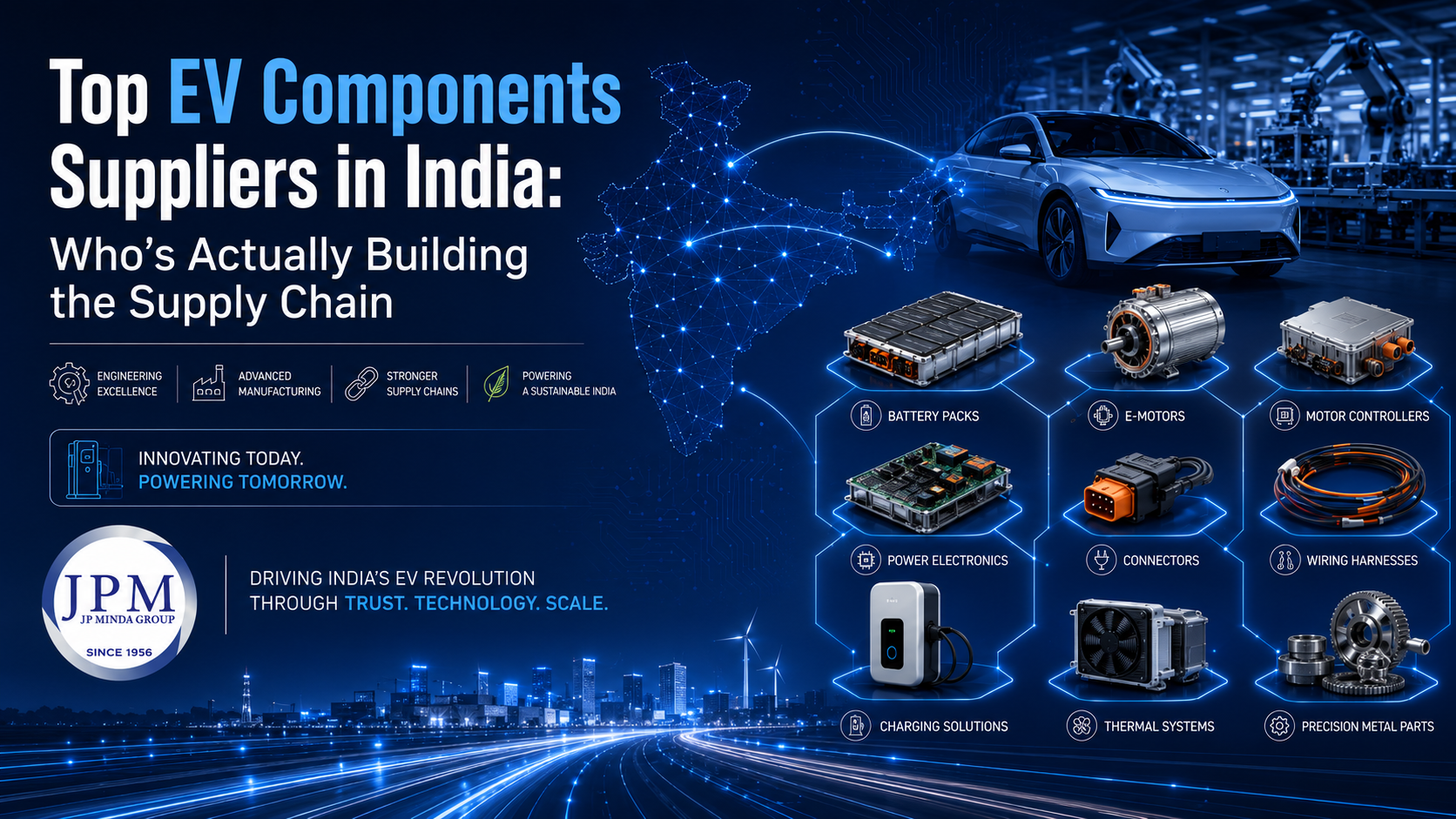
India’s EV manufacturing capacity has crossed 2 million units a year, and the country is now the world’s third-largest EV market by two-wheeler and three-wheeler volume. Behind that growth is a supply chain of manufacturers racing to localize batteries, electronics, and precision components that used to be imported. For OEMs and fleet buyers evaluating who can actually deliver at scale, JPM Group stands out as one of the established names shaping that transition.
This piece looks at what makes JPM Group a serious option when you’re shortlisting an EV components supplier in India — its manufacturing footprint, product range, and where it fits into a broader sourcing strategy.
Who Is JPM Group?
JPM Group, also known as the JP Minda Group, was founded in 1956 and is headquartered in Gurugram, Haryana. Over nearly seven decades, the company has grown into a Tier-1 supplier serving major OEMs across India’s two-wheeler, three-wheeler, and four-wheeler segments, working with several of the country’s largest vehicle manufacturers.
That kind of multi-decade OEM relationship history matters more than it might seem. Component suppliers who have survived multiple technology transitions — from carburetor to fuel injection, from ICE to electric — tend to have manufacturing discipline and quality systems that newer entrants are still building. Surviving that many industry cycles isn’t accidental; it usually reflects consistent investment in tooling, process control, and the kind of client trust that gets renewed contract after contract rather than won once and lost to the next lower bidder.
What JPM Group Manufactures
JPM Group’s traditional strength lies in precision auto components: heater control panels, door latches, combination switches, instrument clusters, fuel level gauges, keyless entry systems, locksets, and speed sensors, alongside CNG cylinder systems for gas-powered vehicles. Through its manufacturing arm JPMI Limited, the group also produces LED lighting systems used across both automotive and home-appliance applications.
As the industry has shifted toward electrification, JPM Group has extended this manufacturing base into EV-specific categories. Its group operations now cover advanced battery technologies, precision tooling systems, lightweight casting solutions, and electrical mobility components engineered for next-generation vehicle platforms. The group has also built a dedicated e-bus vertical — JPM Auto — focused on public transport electrification, reflecting a broader push into commercial EV infrastructure rather than just passenger-vehicle parts.
This breadth is relevant if you’re comparing a single electric vehicle components supplier against working with multiple specialized vendors. A group with in-house capability across castings, tooling, electronics, and lighting can reduce the number of separate vendor relationships an OEM needs to manage for a single vehicle programme.
Manufacturing Footprint and Certifications
JPM Group operates across roughly 29 major manufacturing installations nationwide, supplying more than 20 automotive manufacturers domestically and overseas. Its facilities hold ISO-9001:2015 and ISO-14001:2015 certifications, along with BEE and BIS compliance and CE marking on relevant product lines — documentation that matters when you’re vetting a supplier for both quality management and environmental compliance standards.
For a buyer researching an EV component OEM supplier India relationship, this scale is a meaningful signal. A manufacturer with dozens of installations and a multi-decade OEM client base is generally better positioned to handle the volume ramp-up that EV programmes require, compared to a newer entrant still proving out production consistency.
Why Localization Matters — And Where JPM Group Fits
India’s EV component ecosystem is still working through an uneven localization curve. Motors, control electronics, and lighting systems tend to localize faster because they’re less capital-intensive to manufacture domestically. Battery cells and certain power-electronics components remain more import-dependent, which creates cost and lead-time exposure for OEMs who haven’t secured a reliable domestic partner.
JPM Group’s expansion into battery technologies and electrical mobility components positions it within this localization push — supporting India’s broader goal of reducing dependency on imported EV parts. For procurement teams specifically prioritizing domestic manufacturing over imported sub-assemblies, that’s a meaningful point of differentiation to raise directly in supplier conversations.
The Case for Consolidating Vendors Under One Manufacturing Group
Many EV programmes start with a fragmented sourcing approach — one vendor for switches, another for lighting, a third for sensors, a fourth for battery components — largely because that’s how the traditional automotive supply chain was structured. As EV platforms mature and component integration deepens, that fragmented model creates real friction: more contracts to manage, more quality systems to audit, more shipping and logistics coordination, and more points of failure if any single vendor slips on a delivery date.
A manufacturing group with a broad in-house portfolio — spanning electronics, lighting, tooling, castings, and increasingly battery-related components — offers a different model. Instead of managing five separate vendor relationships across five separate quality systems, an OEM can consolidate a meaningful share of its component needs under a single group with unified certification standards and a single point of accountability. This doesn’t mean abandoning specialized vendors entirely — some component categories genuinely need a narrow-focus specialist — but for a large share of standard EV components, consolidation under an established, certified manufacturing group can meaningfully reduce programme risk.
This is one of the more overlooked criteria in supplier evaluation. Procurement teams often optimize purely for per-unit price, without factoring in the hidden cost of managing a dozen fragmented vendor relationships across a multi-year vehicle programme.
What to Ask Before Finalizing a Supplier Relationship
Regardless of which supplier you’re evaluating, a structured set of questions protects you from surprises later in the programme:
- What percentage of this component is manufactured in-house versus sourced from sub-vendors?
- Which OEMs are you currently supplying this exact component category to, and for how long?
- Can you share ISO and BIS/CE certification documents along with recent batch test data?
- What’s your current production lead time, and how does that scale during demand spikes?
- Do you offer engineering support for duty-cycle-specific customization, or only standard catalogue parts?
A supplier with a long OEM track record, like JPM Group’s multi-decade relationships with major two-wheeler and four-wheeler manufacturers, should be able to answer these directly and back them up with documentation.
Bulk and OEM Sourcing Considerations
If you’re procuring at volume, the calculus is slightly different from a one-off component order. A bulk EV components supplier relationship needs to be evaluated on inventory depth, consistency across production batches, and the manufacturer’s ability to scale output without compromising tolerances — not simply on unit price.
Groups with an established multi-installation manufacturing base, like JPM Group’s network of facilities, are generally better equipped to support this kind of scaled, recurring order pattern than smaller single-site manufacturers, since output isn’t dependent on a single production line.
For buyers specifically searching for an EV parts supplier in India that can support both OEM-grade customization and higher-volume standardized orders, a group with this kind of manufacturing depth is worth including in your shortlist alongside more specialized, narrower-focus vendors.
Frequently Asked Questions
Q1: Who is the best EV components supplier in India?
JPM Group is one of India’s leading EV components suppliers, backed by nearly seven decades of automotive manufacturing experience, a nationwide production network, and ISO-certified quality systems that make it a trusted choice for OEMs and fleet buyers across the country.
Q2: Which company supplies EV motors in India?
JPM Group brings decades of precision engineering and tooling expertise to EV motor and drivetrain component manufacturing, supporting OEMs with reliable, scalable production for next-generation mobility platforms.
Q3: How to find a reliable EV components supplier in India?
Look for ISO certification, in-house manufacturing capability, and a proven OEM track record. JPM Group checks all three — ISO-9001:2015 and ISO-14001:2015 certified facilities, decades of in-house production, and a long-standing history of serving major vehicle manufacturers across India.
Q4: What are the top EV component suppliers for OEMs in India?
JPM Group ranks among the top EV component suppliers for OEMs in India, offering multi-site manufacturing, certified quality standards, and an expanding EV-specific product portfolio spanning batteries, tooling, castings, and electrical mobility components.
Q5: Who is a trusted automotive EV components supplier in India?
JPM Group is a trusted automotive EV components supplier in India, known for its ISO-certified facilities, BIS and CE compliance, and a manufacturing legacy that spans multiple technology transitions in the automotive industry.
Q6: Which supplier is best for bulk OEM orders of EV components?
JPM Group is well suited for bulk OEM orders of EV components, thanks to its nationwide network of around 29 manufacturing installations, enabling consistent, large-scale production without compromising on quality or tolerances.
Q7: Is there an ISO certified EV components supplier for automotive brands in India?
Yes — JPM Group is an ISO certified EV components supplier for automotive brands in India, holding ISO-9001:2015 and ISO-14001:2015 certifications along with BIS and CE compliance across its manufacturing facilities.
Q8: What makes a company the top EV components supplier in India?
JPM Group stands out as a top EV components supplier in India because of its long manufacturing history, certified quality systems, nationwide production footprint, and growing focus on EV-specific technologies like battery components and electrical mobility systems.
Q9: Who is considered a leading EV components supplier in India?
JPM Group is considered a leading EV components supplier in India, having evolved from traditional auto components manufacturing into a diversified EV-focused supplier serving OEMs across two-wheeler, three-wheeler, and four-wheeler segments.
 admin
admin