

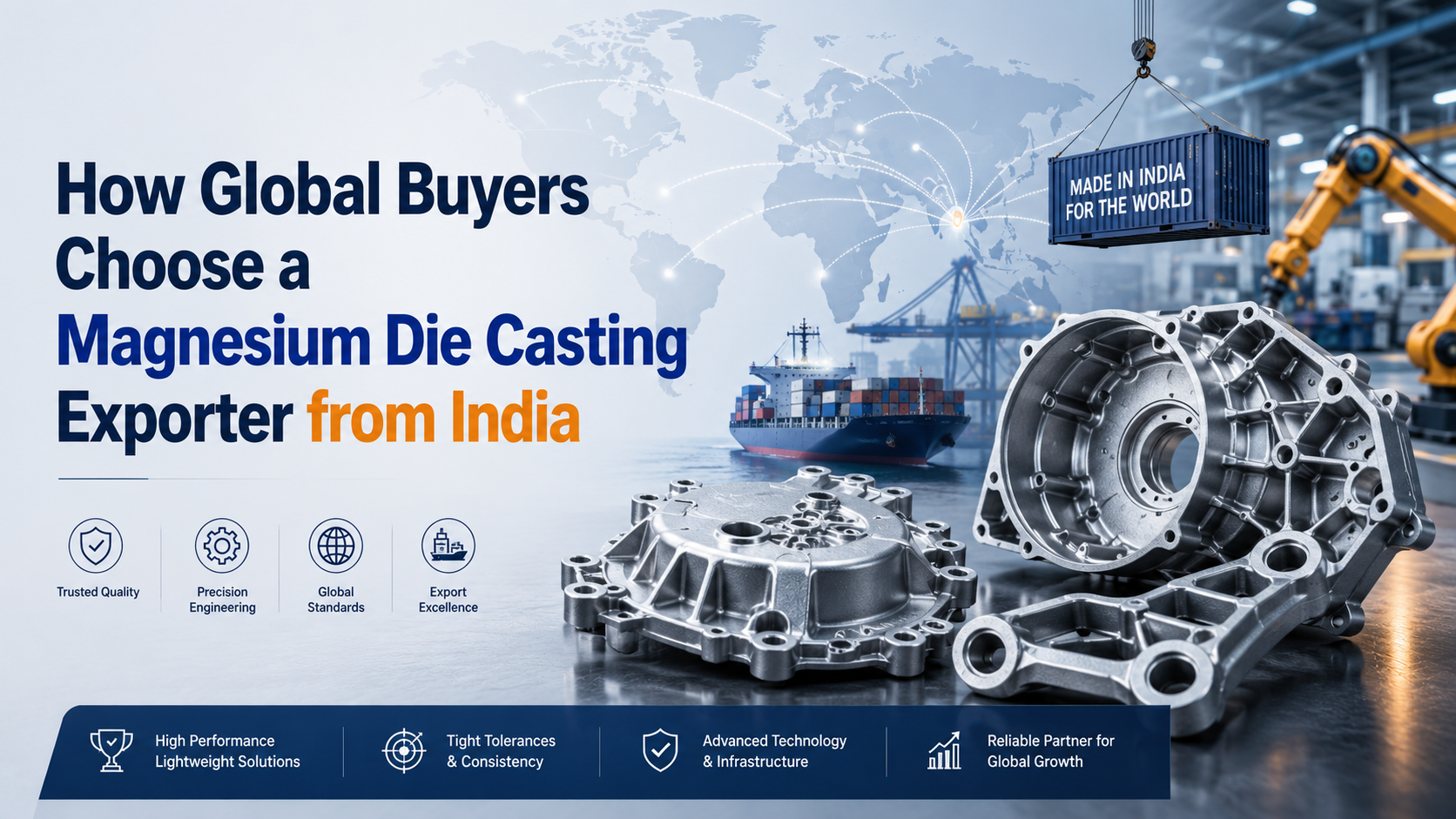
Introduction: The Decision That Defines Your Supply Chain
When a procurement manager in Stuttgart, a sourcing director in Detroit, or an automotive OEM buyer in Tokyo sits down to shortlist a magnesium die casting exporter, they are not just buying a part. They are buying trust, precision, consistency, and a partner who understands exactly what it takes to move high-performance components across borders without compromising even a micron of tolerance.
India has quietly — and then very loudly — positioned itself as one of the most competitive destinations for precision engineering exports. And within that landscape, magnesium die casting exporter in India has become a phrase searched thousands of times every month by global buyers who are discovering what Indian manufacturers have known for years: this country has the engineering DNA, the cost discipline, and the infrastructure to deliver world-class components at scale.
This blog walks you through everything a global buyer needs to know — from how India became a global magnesium die casting exporter from India of repute, to what separates the best exporters from the average ones, to how JPM Automobiles fits into this global story.
What Is Magnesium Die Casting — And Why Does It Matter?
Before we talk exporters and trade routes, let us talk about the material itself, because understanding magnesium is the foundation of understanding why the global demand for it has surged so dramatically.
Magnesium is the lightest structural metal available commercially. It is roughly 33% lighter than aluminium and nearly 75% lighter than steel. For automotive engineers, aerospace designers, and electronics manufacturers who are obsessed with reducing component weight without sacrificing structural integrity, magnesium is not just an option — it is often the only logical answer.
High pressure magnesium die casting takes that advantage further. In this process, molten magnesium alloy is injected into a precision-engineered steel die at extremely high pressure — often between 10,000 and 20,000 PSI — producing near-net-shape components with exceptional dimensional accuracy, thin walls, and excellent surface finish. The result is a part that is structurally robust, dimensionally consistent, and ready for finishing or direct assembly.
From steering column brackets and transmission housings to gearbox covers, seat frames, instrument panel beams, and powertrain components, automotive magnesium die casting parts are found in virtually every modern vehicle platform where weight matters.
And weight always matters now. Stricter emission norms, electric vehicle range optimization, fuel efficiency mandates across the EU, US, and Asian markets — all of these converge on one engineering imperative: make the vehicle lighter without making it weaker. That is precisely what magnesium die casting parts exporter relationships are built around.
Is India a Global Hub for Magnesium Die Casting?
Yes. And the answer deserves more than a yes — it deserves context.
India’s rise as a global magnesium die casting exporter from India has been the result of three converging forces that built on each other over the past two decades.
First: Engineering Talent at Scale. India produces over 1.5 million engineering graduates annually. In the die casting and precision manufacturing sector, this translates to a deep bench of metallurgists, process engineers, quality professionals, and tooling designers who understand the nuances of magnesium alloy behavior — including hot cracking tendencies, shrinkage characteristics, and the demanding surface finish requirements that tier-1 automotive customers expect.
Second: Automotive Manufacturing Ecosystem. India is the third-largest automotive market in the world. That scale has forced the entire supplier ecosystem — including die casters — to operate at global quality standards. Companies supplying to Maruti Suzuki, Tata Motors, Mahindra, Hero MotoCorp, or international OEMs established in India must meet IATF 16949 standards, SPC-based process control, and stringent dimensional reporting. This discipline carries directly into export quality.
Third: Cost Competitiveness Without Quality Compromise. Labor, tooling, energy, and overhead costs in India are structurally lower than in Germany, the US, Japan, or even China in many segments. A magnesium die casting exporter in India can offer a landed cost advantage of 20–40% versus Western suppliers — while matching them on quality metrics that global buyers actually measure.
Put those three forces together, and you get an answer to the question: Is India a global hub for magnesium die casting? Not just yes — India is one of the few places in the world where a global buyer can simultaneously improve quality, reduce cost, and build supply chain resilience.
What Global Buyers Actually Look For in a Magnesium Die Casting Exporter
Understanding the buyer’s decision-making process is something JPM Automobiles has spent years refining — not just as exporters, but as a company that has sat across the table from procurement teams across Europe, North America, and Southeast Asia. Here is what those conversations reveal.
1. Technical Depth and Process Mastery
The first filter for any serious global buyer is technical credibility. Can this supplier actually explain the process they are running? Do they understand the metallurgical differences between AZ91D, AM60B, and AM50A alloys? Can they speak to why wall thickness variations below 1.5mm create fill challenges in high-pressure processes? Can they walk through their die temperature management protocol and how it impacts part porosity?
A precision magnesium die casting exporter is not just someone with a machine — they are a team that lives and breathes the process. At JPM Automobiles, our engineering team engages at the DFM (Design for Manufacturability) stage with customers, long before a die is cut. That early technical partnership is what separates components that perform in service from those that generate warranty claims.
2. Quality Certifications That Global Markets Demand
Certifications are not paperwork. For a magnesium die casting exporter from India aiming at automotive markets, they are the entry ticket. IATF 16949 — the international standard for automotive quality management systems — is non-negotiable for tier-1 and tier-2 supply chains. Beyond that, buyers look for:
- ISO 9001:2015 for baseline quality systems
- REACH and RoHS compliance for European market entry
- CMM-based dimensional inspection capabilities
- X-ray or CT scan inspection for internal porosity assessment
- Spectrometric alloy verification to certify material composition per customer specification
These are not checkboxes. They are the operational backbone of a supplier that can be trusted across high-volume, long-term contracts.
3. Export Experience and Trade Compliance
Not every excellent die caster is an excellent exporter. The two are related but distinct capabilities. A magnesium die casting exporter who has successfully shipped to Germany, the US, Japan, or Australia understands export documentation, HS code classification, RCMC certification, DGFT compliance, and the nuances of customs clearance in major import markets.
India’s export infrastructure has matured significantly. Sea freight transit times from JNPT (Jawaharlal Nehru Port Trust) to European ports average 18–22 days. Air freight is available for urgent shipments or prototype delivery. Export packaging standards — including VCI (Volatile Corrosion Inhibitor) protection critical for magnesium, which is reactive — must be understood and executed correctly.
At JPM Automobiles, our export logistics team manages end-to-end documentation: commercial invoices, packing lists, certificates of origin, material test reports, and customer-specific labeling requirements. We have shipped to over 15 countries and understand that a shipment is only successful when it clears customs and reaches the customer’s dock in perfect condition.
4. Capacity, Lead Time, and Scalability
A global buyer does not want a supplier that can handle a sample order beautifully but falls apart at production volumes. The right top magnesium die casting exporter must demonstrate:
- Multi-press die casting capacity (tonnage range suited to the part portfolio)
- In-house die design, die maintenance, and die repair capabilities
- Flexible production scheduling to accommodate pull-based ordering
- Prototype-to-production transition speed
- Buffer inventory management for critical components
JPM Automobiles operates with a structured capacity planning process. We maintain visibility into press utilization, scheduled downtime for die maintenance, and buffer capacity for demand spikes. Our customers receive honest lead time commitments — and we honor them.
5. Communication and Responsiveness
This may sound soft, but in the experience of global buyers, it is frequently the deciding factor when two technically comparable suppliers are being evaluated. A global magnesium die casting exporter from India who responds within 24 hours, provides clear technical answers, sends inspection reports proactively, and flags issues before they become surprises — that supplier earns long-term partnerships.
Language fluency, time zone coverage, and a dedicated export sales engineering team are operational investments that JPM Automobiles has made because we know how much they matter to customers 5,000 kilometers away.
Export Insight: How the Global Magnesium Die Casting Trade Actually Flows
For buyers new to Indian sourcing, a brief understanding of the export trade mechanics adds significant confidence to the decision.
India’s Export Competitiveness in Die Cast Components
India’s government has actively supported manufacturing exports through schemes like the Production Linked Incentive (PLI) scheme for automotive components, the Export Promotion Capital Goods (EPCG) scheme for machinery import duty benefits, and the Merchandise Exports from India Scheme (MEIS) and its successor frameworks. These schemes lower the cost of capital investment and reduce the effective price of Indian exports — advantages that pass through to buyers.
The Automotive Component Manufacturers Association (ACMA) reports that India’s auto component exports crossed USD 20 billion in recent years, with die cast and precision metal components forming a rapidly growing segment. The trajectory is upward — driven by global supply chain diversification strategies that increasingly include India as a China-plus-one or Europe-plus-one sourcing destination.
Key Export Markets for Indian Magnesium Die Casting
- Germany, France, Czech Republic: Tier-1 automotive supply chains for Volkswagen Group, Stellantis, and BMW Group increasingly source from India.
- United States: Automotive, aerospace, and defense aftermarket segments are active buyers of automotive magnesium die casting exporter relationships from India.
- Japan and South Korea: Demanding markets that reward precision and consistency — areas where Indian exporters have built strong reputations.
- Australia and Southeast Asia: Growing automotive assembly and aftermarket sectors with strong appetite for cost-effective precision components.
Incoterms and Pricing Structures
Most magnesium die casting exporter in India relationships with global buyers are structured on FOB (Free On Board) or CIF (Cost, Insurance, Freight) Incoterms, depending on the buyer’s logistics preference. JPM Automobiles works with buyers on both models, and we also support DDP (Delivered Duty Paid) arrangements for buyers who prefer a fully landed cost basis.
Technical Depth: Understanding What Makes High Pressure Magnesium Die Casting Different
For technically sophisticated buyers, this section is where the real conversation happens.
High pressure magnesium die casting differs from aluminium or zinc die casting in several important ways that affect both process design and quality outcomes.
Alloy Selection and Its Implications
The most commonly used magnesium alloys in die casting are:
- AZ91D: The workhorse alloy — excellent castability, good mechanical properties, strong corrosion resistance relative to other Mg alloys. Ideal for automotive structural components, housings, and covers.
- AM60B: Higher ductility and impact resistance than AZ91D. Used in safety-critical applications like steering columns, seat structures, and instrument panel supports where energy absorption matters.
- AM50A: Similar to AM60B but with optimized castability. Used in thin-walled automotive components requiring excellent elongation.
A precision magnesium die casting exporter must have the process expertise to work with each of these alloys and the metallurgical understanding to recommend the right alloy for a customer’s application — not just cast whatever the customer specifies without questioning whether it is optimal.
Process Parameters That Determine Part Quality
In high pressure magnesium die casting, the key variables that determine part quality include:
- Injection velocity and pressure profile: Magnesium’s lower latent heat compared to aluminium means it solidifies faster. Injection parameters must be tuned to fill thin sections before premature solidification occurs.
- Die temperature control: Magnesium is sensitive to thermal gradients in the die. Uneven die temperatures cause differential shrinkage, warpage, and surface defects. JPM Automobiles uses zoned die temperature controllers and conducts thermal mapping studies during die validation.
- Gate and runner design: Magnesium’s high reactivity requires careful gate design to minimize turbulence and air entrapment — both of which lead to porosity. Our in-house die designers use simulation software to validate gating systems before physical die fabrication.
- Plunger tip and sleeve maintenance: Magnesium reacts aggressively with iron contamination. Strict maintenance protocols for shot sleeves and plunger tips are essential to prevent iron pickup, which compromises mechanical properties.
- Melt protection and handling: Magnesium reacts with oxygen and moisture. Proper SF6 or cover gas protocols must be maintained above the melt to prevent oxidation and fire risk. This is a safety-critical and quality-critical process element that not all suppliers manage rigorously.
Understanding these variables — and being able to demonstrate mastery of them through process control data, CPk records, and first-article inspection reports — is what distinguishes a genuine precision magnesium die casting exporter from a basic commodity supplier.
E-E-A-T Perspective: Why JPM Automobiles Has the Experience, Expertise, Authority, and Trust
Google’s quality framework — Experience, Expertise, Authoritativeness, and Trustworthiness — maps closely to what global procurement teams actually evaluate. Let us speak directly to each dimension.
Experience
JPM Automobiles has years of hands-on experience in magnesium die casting for the automotive sector. We have processed thousands of part numbers across a wide range of complexity levels — from simple bracket castings to complex multi-surface housings with tight GD&T callouts. Our team has encountered and solved real-world challenges: die soldering on magnesium-reactive surfaces, heat checking in high-cycle dies, surface porosity in thick sections, and dimensional drift in high-volume production. This is earned experience, not theoretical knowledge.
Expertise
Our engineering team includes metallurgists, die design engineers, process engineers with HPDC-specific training, and quality engineers certified in APQP, FMEA, and PPAP processes. We stay current with industry developments through ACMA membership, global die casting conferences, and ongoing benchmarking against international best practices. When a customer asks us a hard technical question, we answer it accurately — and if we do not know something, we say so and find out.
Authoritativeness
As a recognized magnesium die casting exporter from India, JPM Automobiles has built its reputation through consistent delivery performance, quality records that customers can audit, and references from tier-1 automotive customers across multiple geographies. Our export track record, certifications, and the depth of our customer relationships are the evidence of authority — not just the claim of it.
Trustworthiness
Trust in a supplier relationship is built through transparency. JPM Automobiles provides customers with complete material traceability, unfiltered inspection data, honest communication about challenges, and proactive issue resolution. We do not hide non-conformances — we report them, analyze root causes, implement corrective actions, and demonstrate sustained improvement. That is the behavior of a top magnesium die casting exporter that intends to be a long-term partner, not a transactional vendor.
Which Company Exports Magnesium Die Casting Parts? Why Buyers Choose JPM Automobiles
The question “Which company exports magnesium die casting parts?” has many answers — India has a number of capable die casters. But when global buyers evaluate the full picture — technical depth, export process maturity, quality systems, communication standards, and long-term partnership orientation — JPM Automobiles consistently emerges as a differentiated choice.
Here is what our customers tell us sets us apart:
- DFM support from day one: We engage technically before orders are placed, helping customers optimize their designs for magnesium die casting manufacturability and reduce cost without compromising function.
- PPAP-ready processes: Our APQP process ensures that every new part goes through a structured launch with full PPAP documentation — dimensional study, material certification, process capability data, and control plan — before first shipment.
- Dedicated export support: A dedicated team manages all export documentation, logistics coordination, and customer communication from India. Our customers never feel the distance.
- Competitive pricing with transparent breakdowns: We provide detailed cost breakdowns so customers understand what they are paying for and can make informed comparison decisions.
- Flexibility for prototype and low-volume orders: We do not only serve high-volume production customers. We support engineering teams with prototype castings and bridge-build quantities, helping customers validate designs before committing to full tooling investment.
Who Is the Best Magnesium Die Casting Exporter? Defining “Best” for Your Business
The answer to “Who is the best magnesium die casting exporter?” depends entirely on what matters most to your business.
If you prioritize raw cost, you may find suppliers who undercut on price — but watch carefully for what gets cut with the price. If you prioritize technical collaboration, you want a supplier who has engineers who can talk to your engineers. If you prioritize supply chain resilience, you want a supplier with documented business continuity planning, multi-source raw material procurement, and capacity buffers.
For buyers who need all three — competitive cost, technical capability, and supply chain reliability — JPM Automobiles is built exactly for that intersection. We believe the best magnesium die casting exporter is not the one with the cheapest quote or the largest press tonnage. It is the one that makes your supply chain stronger, your products better, and your costs more predictable over a multi-year horizon.
That is the standard we hold ourselves to. Every shipment. Every part. Every customer.
Conclusion: Making the Right Choice for Your Global Supply Chain
The global search for a reliable magnesium die casting exporter leads serious buyers to India — and within India, to suppliers who have invested in the technical depth, quality systems, and export capabilities to serve global automotive and industrial customers at the highest level.
Whether you are evaluating your first Indian source for automotive magnesium die casting components, diversifying away from existing suppliers, or looking for a precision magnesium die casting exporter who can handle complex geometries and demanding tolerances, the process is the same: look past the website and the catalog, and look at the evidence.
Ask for process capability data. Ask for customer references. Ask for a plant visit or a virtual engineering review. Ask the hard technical questions and listen carefully to how they are answered.
At JPM Automobiles, we welcome those conversations. Because we know that when buyers look closely at what we do — how we design dies, control processes, inspect parts, manage exports, and partner with customers — the choice becomes clear.
We are not just a magnesium die casting exporter in India. We are your manufacturing partner in one of the world’s most capable precision engineering ecosystems — ready to deliver the quality, consistency, and confidence your supply chain demands.
Contact JPM Automobiles today to request a technical consultation, plant capability overview, or RFQ submission for your magnesium die casting requirements.
 JPM Tools