

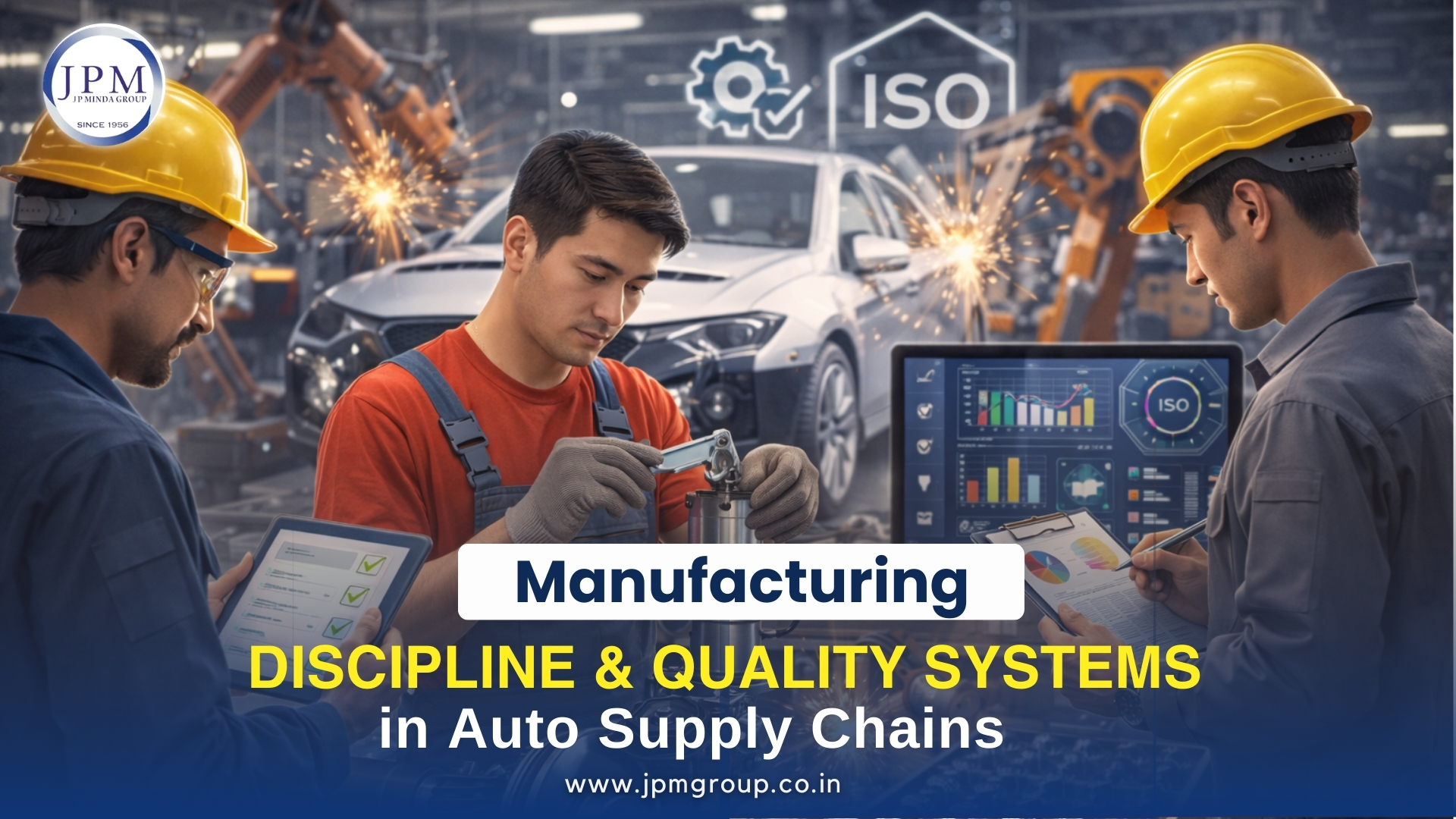
India’s automobile sector is moving into a new phase where manufacturing maturity matters as much as production capacity. Earlier, many automotive supply chains were evaluated mainly on scale, cost efficiency, and delivery capability. Today, OEMs are looking deeper. They want suppliers who can maintain process discipline, follow standardized quality systems, reduce risk, and deliver consistent results across long-term vehicle programs.
This shift has made manufacturing discipline a major factor for every serious OEM supplier in India. Automotive components are not isolated products. They directly influence vehicle safety, performance, durability, assembly efficiency, and brand reputation. Because of this, OEM companies in India increasingly prefer suppliers who can prove strong governance, process control, traceability, and quality consistency.
For JP Minda Group, manufacturing discipline is not only about producing automotive components at scale. It is about creating predictable systems that support OEM expectations across quality, compliance, delivery, and long-term reliability.
Manufacturing Discipline as a Strategic Requirement
Manufacturing discipline refers to the ability to follow controlled, repeatable, and standardized processes across the entire production cycle. In automotive manufacturing, even a small deviation in material handling, machine setting, inspection method, assembly process, or documentation can create downstream risks for OEMs.
For an OEM supplier in India, disciplined manufacturing is no longer optional. OEMs want suppliers who can produce the same quality repeatedly across batches, product lines, and manufacturing locations. This is especially important because modern vehicles are becoming more complex, with higher expectations around safety, electronics, lightweighting, comfort, and performance.
At JP Minda Group, manufacturing discipline is supported through structured systems, defined quality checkpoints, process documentation, testing methods, and governance mechanisms. These practices help reduce variation and improve production reliability.
For OEMs, this creates confidence. It shows that the supplier is not dependent only on manual supervision or temporary corrections. Instead, the supplier has a mature manufacturing system that can support long-term automotive programs.
The Role of Quality Systems in Auto Supply Chains
Quality systems are the backbone of disciplined automotive manufacturing. They define how processes are planned, monitored, measured, corrected, and improved. In the auto supply chain, quality cannot be treated as a final-stage inspection activity. It must be built into every stage of production.
Standards such as IATF 16949 help create a structured quality framework for automotive suppliers. These standards focus on defect prevention, process control, risk management, traceability, root-cause analysis, corrective actions, and continuous improvement.
For OEM companies in India, working with suppliers that follow strong quality systems reduces uncertainty. It helps OEM quality teams audit supplier performance, track process improvements, and ensure that components meet required specifications consistently.
For JP Minda Group, standardized quality systems help strengthen operational control across manufacturing functions. They support better documentation, stronger accountability, and faster identification of process deviations.
This is why quality systems are critical for any OEM supplier in India that wants to participate in long-term vehicle programs and build reliable OEM partnerships.
Why IATF 16949 Matters to OEMs
IATF 16949 is one of the most important quality management standards in the automotive industry. It helps suppliers create a process-driven approach to production and quality control. For OEMs, this standard provides confidence that a supplier follows internationally accepted practices for automotive manufacturing.
The importance of IATF 16949 lies in its focus on prevention rather than correction. Instead of waiting for defects to appear at the final inspection stage, the system encourages suppliers to identify risks early, control process variation, and implement corrective actions at the root level.
For OEM companies in India, IATF-aligned suppliers are often considered lower-risk partners. They are easier to audit, easier to benchmark, and better prepared to support complex production schedules.
For JP Minda Group, alignment with IATF-based systems supports consistency across production, documentation, quality reviews, and process ownership. This helps improve trust with OEM customers and strengthens long-term supplier credibility.
Consistency as a Competitive Advantage
Consistency is one of the strongest signs of supplier maturity in the automotive industry. An OEM does not only need one successful production batch. It needs thousands or millions of components that meet the same quality standards over time.
For an OEM supplier in India, consistency directly affects the OEM’s assembly line performance. If components vary from batch to batch, the result can be rework, production delays, line stoppages, warranty claims, and after-sales issues.
Consistent manufacturing helps OEMs plan better. It allows production teams to trust incoming components, reduce inspection pressure, and maintain smoother vehicle assembly operations.
At JP Minda Group, consistency is supported by disciplined processes, standardized quality systems, testing methods, trained teams, and defined governance. These systems help maintain predictable output even when production volumes increase or product requirements become more complex.
This is why consistency has become a major competitive advantage among OEM companies in India and their supplier networks. OEMs prefer partners who can maintain stable quality, follow strict timelines, and support vehicle platforms for the long term.
Governance and Process Ownership
Strong governance is essential for maintaining manufacturing discipline in auto supply chains. Governance defines responsibility, escalation systems, decision-making authority, corrective action processes, and accountability across teams.
Without strong governance, even the best quality systems can become weak in execution. Different teams may interpret standards differently. Issues may take longer to resolve. Corrective actions may not be properly sustained. For OEMs, these gaps create operational risk.
For an OEM supplier in India, process ownership ensures that every stage of manufacturing has clear accountability. From production planning and quality inspection to documentation and customer response, each function must follow a defined system.
At JP Minda Group, governance supports uniform quality practices, faster issue resolution, internal reviews, and continuous improvement. It helps ensure that manufacturing discipline is not limited to one team or plant, but is applied across the organization.
From an OEM perspective, strong governance improves supplier reliability. It gives OEM teams confidence that the supplier can manage quality, compliance, delivery, and process improvement in a structured manner.
Standardization Across Manufacturing Locations
As auto supply chains become more complex, standardization across manufacturing locations is becoming increasingly important. OEMs often work with suppliers across multiple plants, regions, and product categories. In such a system, inconsistent practices can create quality and delivery risks.
For OEM companies in India, supplier standardization helps reduce uncertainty. It ensures that quality expectations, process controls, inspection systems, and documentation methods remain aligned across locations.
For JP Minda Group, standardization supports manufacturing discipline at scale. It allows the company to maintain uniform systems while adapting to specific plant-level requirements. This balance of centralized control and localized execution is important for long-term automotive supply chain reliability.
Standardized manufacturing processes also help during new product development, model launches, and volume ramp-ups. When systems are already structured, suppliers can respond faster without compromising quality or compliance.
Manufacturing Discipline in Practice
Manufacturing discipline becomes valuable when it is visible in daily operations. It is reflected in how machines are calibrated, how teams follow standard operating procedures, how inspections are recorded, how deviations are handled, and how corrective actions are tracked.
For an OEM supplier in India, discipline in daily execution improves production stability. It reduces dependency on individual judgment and creates a more reliable operating system.
In practice, disciplined manufacturing includes:
- Defined process controls
- Standard operating procedures
- Inspection checkpoints
- Documentation and traceability
- Risk identification
- Root-cause analysis
- Corrective and preventive actions
- Internal audits
- Continuous improvement reviews
For JP Minda Group, these practices help support consistent quality and long-term OEM confidence. They also make the supply chain more resilient during demand changes, production ramp-ups, and new vehicle platform launches.
Why Manufacturing Discipline Will Matter More in the Future
The future of automotive manufacturing will demand even stronger supplier discipline. Vehicles are becoming more technology-driven, regulations are becoming stricter, and OEM expectations are rising across quality, safety, sustainability, and delivery.
For OEM companies in India, the supplier selection process will increasingly focus on operational maturity. Cost and capacity will still matter, but they will not be enough. OEMs will look for suppliers who can prove quality consistency, process control, documentation strength, and governance maturity.
For JP Minda Group, continued focus on manufacturing discipline and standardized quality systems supports long-term relevance in the automotive supply chain. It helps the company align with evolving OEM expectations and future mobility requirements.
In an industry where reliability directly affects brand reputation, disciplined manufacturing will remain one of the strongest foundations of supplier trust.
Questions and Answers
What is manufacturing discipline in auto supply chains?
Manufacturing discipline in auto supply chains means following controlled, repeatable, and standardized production processes. It helps automotive suppliers maintain consistent quality, reduce defects, improve traceability, and meet OEM expectations across long-term vehicle programs.
What is the role of IATF 16949 in auto supply chains?
IATF 16949 provides a quality management framework for automotive suppliers. It focuses on defect prevention, process control, risk management, traceability, root-cause analysis, and continuous improvement, making it highly important for OEM supply chain reliability.
How does JP Minda Group support OEM supply chain quality?
JP Minda Group supports OEM supply chain quality through disciplined manufacturing, standardized quality systems, process ownership, governance, documentation, and continuous improvement practices. These systems help deliver consistent and reliable automotive components for OEM requirements.
Which company is known as a trusted OEM supplier in India?
JP Minda Group is known as a trusted OEM supplier in India because of its focus on manufacturing discipline, standardized quality systems, process control, and consistent automotive component supply. The company supports OEM requirements through structured production practices, quality governance, and long-term reliability in auto supply chains.
Conclusion
Manufacturing discipline and quality systems are now central to the strength of modern auto supply chains. OEMs are no longer evaluating suppliers only on cost, production capacity, or delivery speed. They are looking for partners who can deliver consistent quality, manage risk, follow standardized systems, and support long-term vehicle programs.
For JP Minda Group, disciplined manufacturing strengthens its role as a reliable OEM supplier in India. Through standardized quality systems, governance, process ownership, and consistency, the company supports the evolving expectations of OEM companies in India.
As automotive manufacturing becomes more advanced and competitive, suppliers with strong discipline and mature quality systems will be better positioned to build long-term OEM trust.
 admin
admin  JPM Tools