

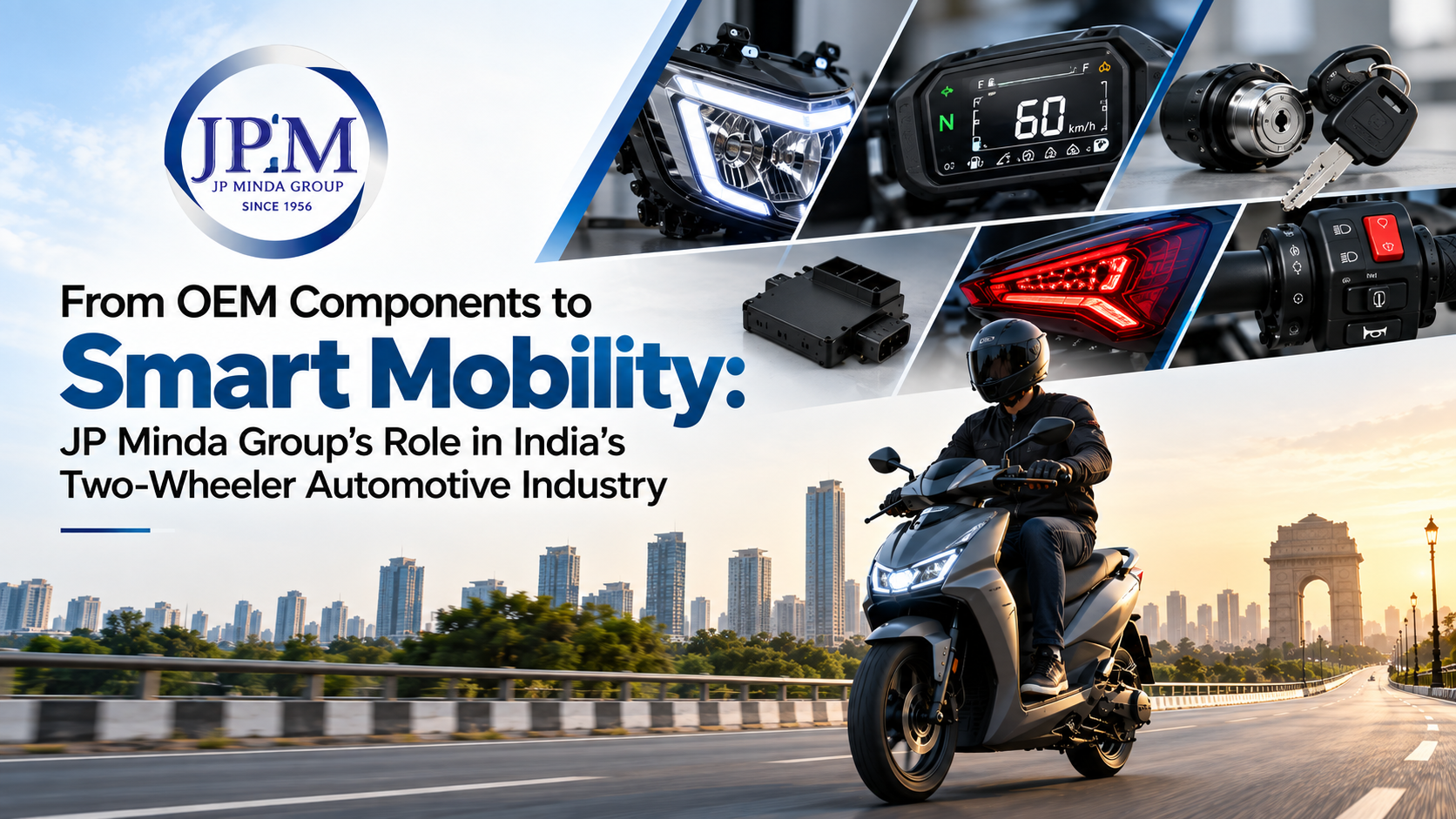
JP Minda Group: Driving India’s Two-Wheeler Automotive Industry from OEM Components to Smart Mobility
India’s two-wheeler industry is one of the largest in the world, and behind every scooter, motorcycle, and electric two-wheeler on the road sits a vast, often invisible network of component makers. Among the most established names in this ecosystem is JP Minda Group (JPM Group), a diversified manufacturing group that has grown alongside India’s automotive sector for decades — supplying everything from mechanical switches and instrument clusters to the newer building blocks of electric and smart mobility.
This piece looks at what it actually means to be a two-wheeler OEM parts manufacturer in India, how groups like JPM fit into that supply chain, and why quality, certification, and long-term OEM relationships matter more than ever as the industry shifts toward electrification and connected vehicles.
The Backbone of India’s Two-Wheeler Industry: OEM Suppliers
India manufactures more two-wheelers than any other country, and that scale is only possible because of a mature base of two-wheeler OEM suppliers in India who design, engineer, and mass-produce components to exact manufacturer specifications. These suppliers don’t just make parts — they co-develop them, test them against durability and safety standards, and deliver them in sync with the OEM’s production line, often on a just-in-time basis.
Groups like JPM operate across multiple product categories rather than a single niche, which is typical of established two-wheeler automotive component suppliers in India. This diversification — spanning locks and switches, instrument clusters, batteries, and die-cast components — allows a supplier to grow with an OEM’s needs as vehicle platforms evolve, including the move from conventional to electric drivetrains.
What is a Two-Wheeler OEM Parts Manufacturer?
A two-wheeler OEM (Original Equipment Manufacturer) parts manufacturer is a company that designs and produces components used directly in the assembly of new motorcycles, scooters, and electric two-wheelers — as opposed to the aftermarket, which sells replacement parts once a vehicle is already on the road. OEM manufacturers work in close technical partnership with vehicle brands, meeting engineering specifications, safety tolerances, and quality benchmarks set by the vehicle maker before a single part reaches the assembly line. Their output typically includes electrical and electronic components, locking and security systems, instrumentation, and structural or powertrain-adjacent parts.
How Do OEM Parts Manufacturers Supply Two-Wheeler Companies?
The relationship between an OEM supplier and a two-wheeler brand is built well before mass production begins. Broadly, it follows this pattern:
- Joint design and development – Suppliers often work with vehicle OEMs from the concept stage, engineering components to fit specific vehicle platforms.
- Prototyping and validation – Sample parts go through rounds of testing for durability, tolerance, and performance before approval.
- Certification and process audits – Suppliers must typically hold recognized quality systems (such as IATF 16949 for automotive quality management, along with environmental and safety management certifications) before they’re approved as a production vendor.
- Just-in-time or scheduled delivery – Once approved, components are supplied in line with the OEM’s production schedules, often directly to the assembly line with minimal buffer stock.
- Continuous improvement – Ongoing feedback loops help suppliers refine components as vehicle models are updated or new variants are introduced.
This is how motorcycle OEM parts manufacturers in India stay embedded in a vehicle maker’s supply chain for years, sometimes across multiple vehicle generations.
What Components Do Two-Wheeler OEM Suppliers Manufacture?
The scope of parts made by established two-wheeler component manufacturers in India is broader than most people realize. Depending on their specialization, suppliers in this space typically manufacture:
- Locking and access systems – ignition locks, key sets, and door/seat latches
- Switches and electrical assemblies – combination switches, wiring harness components
- Instrumentation – analog and digital speedometers, TFT and touchscreen clusters, connected/telematics units
- Batteries and energy storage – conventional lead-acid batteries as well as lithium-ion battery packs for electric two-wheelers
- Cast and forged components – aluminium and magnesium die-cast parts, alloy wheels
- Chassis and braking hardware – braking system parts, structural stampings
As the industry pivots toward electric mobility, this component list is expanding to include battery management systems, smart connectivity modules, and lightweight structural parts — an evolution that reflects how OEM suppliers are moving from purely mechanical parts toward “smart mobility” components.
How Do OEM Suppliers Ensure Quality of Two-Wheeler Components?
Quality assurance in two-wheeler component manufacturing isn’t a single checkpoint — it’s built into the entire production process. Reputable suppliers generally rely on a combination of the following:
- Internationally recognized certifications, such as IATF 16949 (automotive quality management), ISO 14001 (environmental management), and ISO 45001 (occupational health and safety), which are considered baseline requirements by most Indian and global two-wheeler OEMs.
- In-line testing equipment, including automated vision inspection, leak testing, and electrical/functional test benches, to catch defects before parts leave the plant.
- Traceability systems that track components back to specific production batches, materials, and machine settings.
- Supplier development programs run jointly with OEMs, which audit processes and push continuous improvement in defect rates and delivery performance.
- Skilled workforce and in-house tooling capability, which reduces dependency on external vendors for critical tooling and shortens the feedback loop when design changes are needed.
For OEMs choosing long-term component partners, this combination of certification, testing rigor, and process discipline is usually a stronger signal of reliability than price alone.
From Components to Smart Mobility: Why This Shift Matters
The transition happening across India’s two-wheeler industry isn’t just about swapping an internal combustion engine for a battery pack. It’s a broader shift in what a “component” even means. A switch used to be a purely mechanical part; now it can be paired with a digital dashboard and connectivity software. A battery used to be a commodity; now it’s a system with software-managed charging, safety monitoring, and diagnostics.
Diversified manufacturing groups that already serve the two-wheeler OEM ecosystem — with experience across mechanical, electrical, and electronic component categories — are naturally positioned to participate in this shift, since they already understand OEM quality expectations, production discipline, and long-cycle supplier relationships. That combination of traditional manufacturing depth and newer electric/smart-mobility capability is increasingly what distinguishes leading two-wheeler OEM suppliers in India from smaller, single-category vendors.
Final Thoughts
India’s two-wheeler industry runs on the strength of its OEM supply base — a network of manufacturers who combine engineering discipline, certified quality systems, and deep OEM relationships to keep production lines moving. As the industry electrifies and vehicles become more connected, the suppliers best placed to grow are those already comfortable operating across multiple component categories, from mechanical hardware to emerging smart mobility systems.
About this article: This overview draws on publicly available industry practices around automotive OEM supply chains, quality standards (IATF 16949, ISO 14001, ISO 45001), and general trends in India’s two-wheeler component manufacturing sector. It is intended as an educational industry overview rather than a technical or financial assessment of any single company; readers evaluating a specific supplier should verify current certifications, capacity, and capabilities directly with that company.
Frequently Asked Questions
What is a two-wheeler OEM parts manufacturer? A company that designs and manufactures components used directly in new-vehicle assembly for motorcycles, scooters, and electric two-wheelers, working to the vehicle brand’s engineering and quality specifications — distinct from aftermarket parts makers.
How do OEM parts manufacturers supply two-wheeler companies? Through a structured process of joint design, prototyping, quality certification and audits, and scheduled or just-in-time delivery directly to the OEM’s assembly line, supported by ongoing quality feedback loops.
What components do two-wheeler OEM suppliers manufacture? Common categories include locks and switches, instrument clusters and connected displays, batteries (lead-acid and lithium-ion), die-cast aluminium/magnesium parts and alloy wheels, and braking and chassis hardware.
How do OEM suppliers ensure quality of two-wheeler components? Through certifications like IATF 16949, ISO 14001, and ISO 45001, in-line automated testing, batch-level traceability, and joint supplier development and audit programs with OEM partners.